
Day trading in the Forex market requires speed, discipline, and accurate decision-making. Since currency prices move quickly, traders often rely on technical indicators to identify trends, momentum, entry points, and potential reversals. Choosing the right Forex indicators can significantly improve trading accuracy and reduce emotional decisions.
However, no indicator is perfect on its own. Successful traders combine multiple indicators with proper risk management and market analysis. In this guide, we will explore the best Forex indicators for day trading success, how they work, and how you can use them effectively in your strategy.
Why Forex Indicators Matter in Day Trading
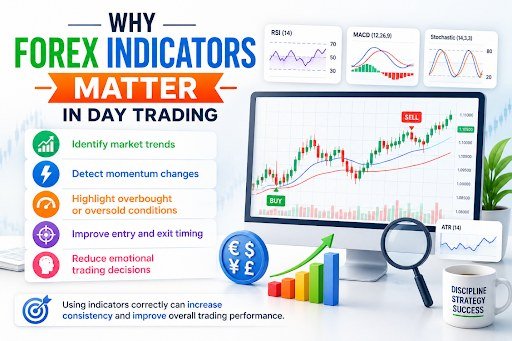
Forex indicators help traders analyze price movements using mathematical calculations based on historical data such as price, volume, and volatility. These tools simplify market analysis and provide signals that traders can use to make informed decisions.
For day traders, indicators are especially useful because they:
- Identify market trends
- Detect momentum changes
- Highlight overbought or oversold conditions
- Improve entry and exit timing
- Reduce emotional trading decisions
Using indicators correctly can increase consistency and improve overall trading performance.
Best Forex Indicators for Day Trading
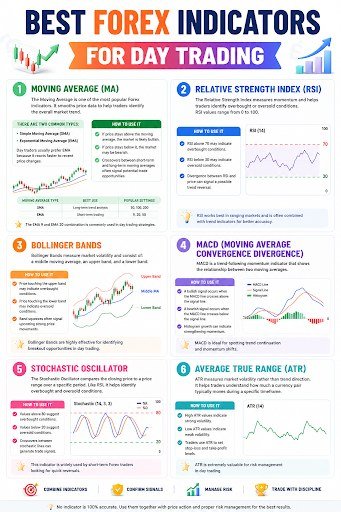
1. Moving Average (MA)
The Moving Average is one of the most popular Forex indicators. It smooths price data to help traders identify the overall market trend.
There are two common types:
- Simple Moving Average (SMA)
- Exponential Moving Average (EMA)
Day traders usually prefer EMA because it reacts faster to recent price changes.
How to Use It
- If price stays above the moving average, the market is likely bullish.
- If price stays below it, the market may be bearish.
- Crossovers between short-term and long-term moving averages often signal potential trade opportunities.
2. Relative Strength Index (RSI)
The Relative Strength Index measures momentum and helps traders identify overbought or oversold conditions.
RSI values range from 0 to 100.
How to Use It
- RSI above 70 may indicate overbought conditions.
- RSI below 30 may indicate oversold conditions.
- Divergence between RSI and price can signal a possible trend reversal.
RSI works best in ranging markets and is often combined with trend indicators for better accuracy.
3. Bollinger Bands
Bollinger Bands measure market volatility and consist of:
- A middle moving average
- An upper band
- A lower band
When volatility increases, the bands expand. When volatility decreases, the bands contract.
How to Use It
- Price touching the upper band may indicate overbought conditions.
- Price touching the lower band may indicate oversold conditions.
- Band squeezes often signal upcoming strong price movements.
Bollinger Bands are highly effective for identifying breakout opportunities in day trading.
4. MACD (Moving Average Convergence Divergence)
MACD is a trend-following momentum indicator that shows the relationship between two moving averages.
It consists of:
- MACD line
- Signal line
- Histogram
How to Use It
- A bullish signal occurs when the MACD line crosses above the signal line.
- A bearish signal occurs when the MACD line crosses below the signal line.
- Histogram growth can indicate strengthening momentum.
MACD is ideal for spotting trend continuation and momentum shifts.
5. Stochastic Oscillator
The Stochastic Oscillator compares the closing price to a price range over a specific period.
Like RSI, it helps identify overbought and oversold conditions.
How to Use It
- Values above 80 suggest overbought conditions.
- Values below 20 suggest oversold conditions.
- Crossovers between stochastic lines can generate trade signals.
This indicator is widely used by short-term Forex traders looking for quick reversals.
6. Average True Range (ATR)
ATR measures market volatility rather than trend direction.
It helps traders understand how much a currency pair typically moves during a specific timeframe.
How to Use It
- High ATR values indicate strong volatility.
- Low ATR values indicate weak volatility.
- Traders use ATR to set stop-loss and take-profit levels.
ATR is extremely valuable for risk management in day trading.
How to Choose the Right Forex Indicators
Not every indicator works for every trading style. Choosing the right tools depends on your strategy, personality, and market conditions.
Consider the following factors:
Trading Style
Scalpers may prefer fast indicators like EMA and Stochastic, while swing traders often use SMA and MACD.
Market Conditions
- Trend indicators perform best in trending markets.
- Oscillators work better in ranging markets.
Simplicity
Too many indicators can create confusion and conflicting signals. Most professional traders use only 2–4 indicators.
Backtesting
Always test indicators on historical data before using them in live trading.
Common Mistakes Traders Make with Indicators
Many beginners misuse Forex indicators and expect perfect signals. Here are the most common mistakes to avoid:
Using Too Many Indicators
Chart clutter leads to confusion and delayed decisions.
Ignoring Price Action
Indicators should support price analysis, not replace it completely.
Blindly Following Signals
No indicator guarantees profits. Traders must consider market context and risk management.
Not Adjusting Settings
Default settings may not work for every timeframe or currency pair.
Trading Without a Plan
Indicators are tools, not complete trading systems.
Avoiding these mistakes can significantly improve trading discipline and consistency.
Tips for Successful Forex Day Trading
To maximize the effectiveness of Forex indicators, follow these practical tips:
- Focus on major currency pairs with high liquidity
- Trade during active market sessions
- Use proper stop-loss levels
- Risk only a small percentage per trade
- Keep emotions under control
- Maintain a trading journal
- Combine technical and fundamental analysis
Consistency and discipline are more important than finding a “perfect” indicator.
Conclusion
Forex indicators are essential tools for day traders looking to improve accuracy and make smarter trading decisions. Indicators like Moving Averages, RSI, MACD, Bollinger Bands, Stochastic Oscillator and ATR each provide unique insights into market behavior.
The key to day trading success is not relying on a single indicator but combining multiple tools with strong risk management and market understanding. Traders who practice patience, backtest their strategies, and stay disciplined are more likely to achieve long-term profitability in the Forex market.
Whether you are a beginner or an experienced trader, mastering these Forex indicators can help you navigate the fast-moving currency market more effectively.
The post Best Forex Indicators for Day Trading Success appeared first on Trade Brains Features.