
Synopsis: AI is starting to change how people plan and book travel, and not all companies may benefit equally. While some depend on users opening their apps, others work behind the scenes. The real opportunity could lie with companies that are less visible but more deeply connected to how travel actually works.
Artificial intelligence is starting to change how travel is searched, discovered and booked, and that may create a very different hierarchy across travel companies. The biggest risk does not appear to be evenly spread. Based on the Q3FY26 data shared by the companies, the pressure looks higher on front-end travel apps that depend heavily on user traffic and transactions, while platforms that sit deeper in the travel stack may be better placed to adapt. That is where RateGain and TBO Tek begin to stand out against companies like Le Travenues, the company behind Ixigo.
The core divide is between front-end apps and travel infrastructure
The simplest way to understand the difference is this. Ixigo largely earns when a user comes to its platform and books a flight, train or bus ticket. Its own Q3 commentary remained centered on transaction growth, revenue growth, contribution margins and customer experience improvements inside its apps, which still makes it a consumer-facing transaction platform at heart. Even where it is investing in AI, the effort is largely aimed at making the app, support stack and user journey better.
RateGain and TBO Tek are built differently. RateGain is positioning itself as a travel technology stack for hotels, destinations and other travel customers across acquisition, engagement, distribution and revenue optimization. TBO Tek is a two-sided B2B travel distribution platform connecting travel agents to hotels, airlines and ancillary products, with payment, support, API and settlement infrastructure layered in. In other words, RateGain and TBO are closer to the pipes and plumbing of travel, while Ixigo is much closer to the app interface that the user sees.
That distinction matters because TBO directly argues that AI may become the new booking demand channel and shift traffic away from search engines, OTAs and front-end interfaces. It says moats built around UI, SEO, search rankings and sponsored listings could weaken because AI bots do not care about them, while B2B players remain largely unaffected because search engines were never the main demand channel for them.
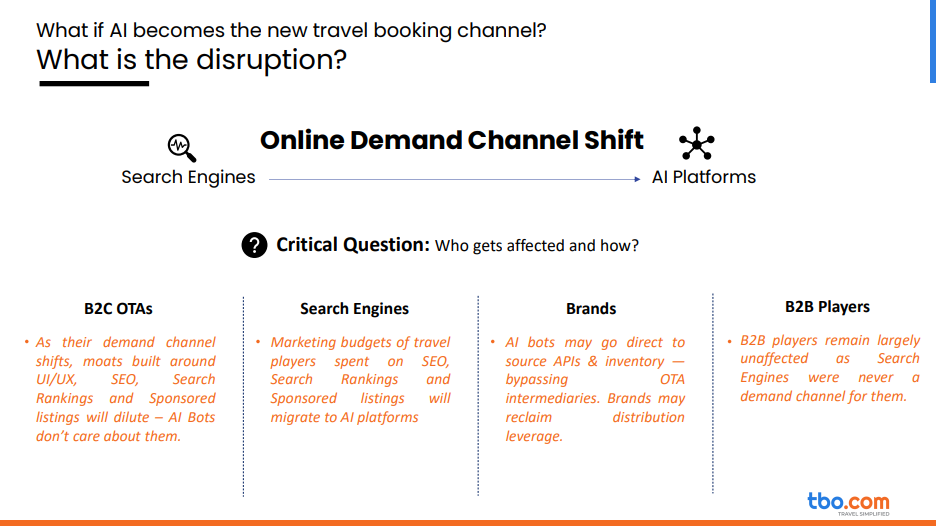
Source: TBO Tek Investor Presentation
RateGain is preparing to work with AI rather than fight it
RateGain’s Q3FY26 earnings call was the clearest on how it sees this shift. Management said travelers are increasingly using conversational AI platforms and intelligent search tools to plan trips, and hotels and destinations are now asking how to show up effectively in that environment. RateGain’s answer is not to try to own that front-end traffic. Instead, it said it has built integrations that allow hotel partners to distribute structured content and availability into these emerging discovery channels so that as search behavior changes, its customers remain visible and bookable.
This is a very important strategic difference. RateGain is not trying to protect the old interface. It is trying to make itself useful in the new one. Management also said the company is moving increasingly toward performance-linked pricing where customers pay based on outcomes delivered, and that it monetizes when it creates measurable revenue lift. That means it is not relying only on a single booking moment. It can participate across discovery, marketing, pricing, conversion and guest engagement.
The other reason RateGain looks safer is that it is trying to build a broader AI-powered stack rather than a single product. Management talked about Demand AI, Rev AI, Navigator AI, smart ARI, AI Concierge and UNO VIVA, its AI voice agent. It also highlighted commercial traction in AI Concierge, saying hotels using it are seeing up to 300 percent increase in ancillary revenue, 75 percent improvement in NPS and automation of up to 80 percent of guest queries. That is a practical use case tied to monetization, not just an experiment.
On top of that, the Sojern integration appears to be adding scale to this strategy. The company said it had already executed about 12 million dollars in annualized cost savings within the first 100 days and was unifying products and go-to-market teams to create one commercial engine. So the near-term plan is clear: integrate, cross-sell, unify the stack and use AI to strengthen the value proposition further.
TBO Tek is betting that AI changes the front end, not the need for distribution
TBO Tek is unusually direct about the AI threat. It lays out three fears: AI becoming the booking channel, AI replacing travel advisors and software becoming cheap and customizable. But the company’s core message is that even if AI changes the way demand comes in, travel distribution platforms will still remain booking enablers because the real value sits in global supply, B2B rates, payment solutions, post-booking service infrastructure and booking APIs. It also argues that if software becomes cheaper to build, then platforms whose value lies only in the front end become vulnerable, while infrastructure, integrations, relationships and data systems become more valuable.
That thinking lines up well with TBO’s actual business model. The company described itself as a two-sided platform with 50,000 plus annual transacting agents, more than 1 million hotels in inventory, 750-plus airlines, payment rails across 88 currencies, near-shored support in 16 languages, deep API integrations and operations across 140 source markets. These are not assets that are easy to replicate with a new app interface.
TBO is also leaning into categories where management believes AI will be less disruptive. The company says luxury assisted travel behaves differently because high-value, complex, multi-country itineraries still benefit from human reassurance and lived destination expertise. That is one reason the Classic Vacations acquisition matters so much. Management said the deal gave TBO access to about 10,000 active luxury travel advisors in North America and deep relationships with consortiums such as Virtuoso, Signature, Travel Leaders and Travel Savers. Cross-sell has already started, platform migration is under way and benefits are expected to start accruing later, with the broader North America opportunity being the real long-term thesis.
The company also explained how they want to use AI positively. It talks about an AI itinerary creator, AI-ready workflows, deeper entrenchment in agent workflows, higher stickiness and wallet share, and automation-led cost opportunities. In short, TBO is not presenting AI as something that destroys its model. It is presenting AI as something that can make its B2B network more efficient and more embedded.
Ixigo understands the disruption well, but it still looks more exposed
In its Q3FY26 earnings call, the company said AI is a once-in-a-lifetime technology transition, even bigger than the emergence of the internet or smartphones. It went further and said software as we know it faces a slow death, that interfaces will no longer need to be fixed artifacts, and that many existing applications may fade into the background while AI-native players replace the experience.
That is sharp thinking, but it also reveals the risk. Ixigo is still primarily a front-end travel app business. Its strongest Q3 points were around transaction growth in flights, trains and buses, improved profitability, AI-led customer support, proactive outbound calls, TARA the AI agent, Flight Tracker Pro, AI summaries for hotels and smarter ranking algorithms. All of this strengthens customer experience and may improve retention, but it does not change the fact that the company still depends heavily on consumers opening its products and booking through them.
On AI, Ixigo also said it wants to invest in, partner with or acquire AI-first teams and products that fit its travel ecosystem. That sounds forward-looking, but it also suggests the company is still searching for the right structure for the next phase.
The safer setup, the bigger risks, and what comes next
The broad conclusion is that RateGain and TBO Tek look safer because both are positioning themselves as infrastructure and workflow enablers in a world where AI may increasingly sit at the discovery layer. RateGain is building tools that help customers remain visible and bookable in AI-driven search while monetizing across outcomes, not just bookings. TBO is arguing that AI weakens front-end moats more than backend distribution, and it is doubling down on agent-led, luxury and infrastructure-heavy parts of travel where that logic could hold better.
That does not mean either company is risk-free. RateGain still has integration work to execute, and TBO still has to prove that Classic and North America can create the expected long-term payoff. But compared with a consumer-facing app that may be more directly exposed if AI starts owning trip planning and search, both seem to have a more defensible starting point.
The blunt view is this: Ixigo may still build strong products and stay relevant, but it appears to be operating closer to where disruption first shows up. RateGain and TBO Tek appear to be standing one layer deeper in the travel value chain. In a period like this, that may matter a great deal more than a better app.
Disclaimer: The views and investment tips expressed by investment experts/broking houses/rating agencies on tradebrains.in are their own, and not that of the website or its management. Investing in equities poses a risk of financial losses. Investors must therefore exercise due caution while investing or trading in stocks. Trade Brains Technologies Private Limited or the author are not liable for any losses caused as a result of the decision based on this article. Please consult your investment advisor before investing.
The post Why RateGain and TBO Tek Could Be the Safer Tourism Play as AI Disrupts Travel Apps appeared first on Trade Brains.