
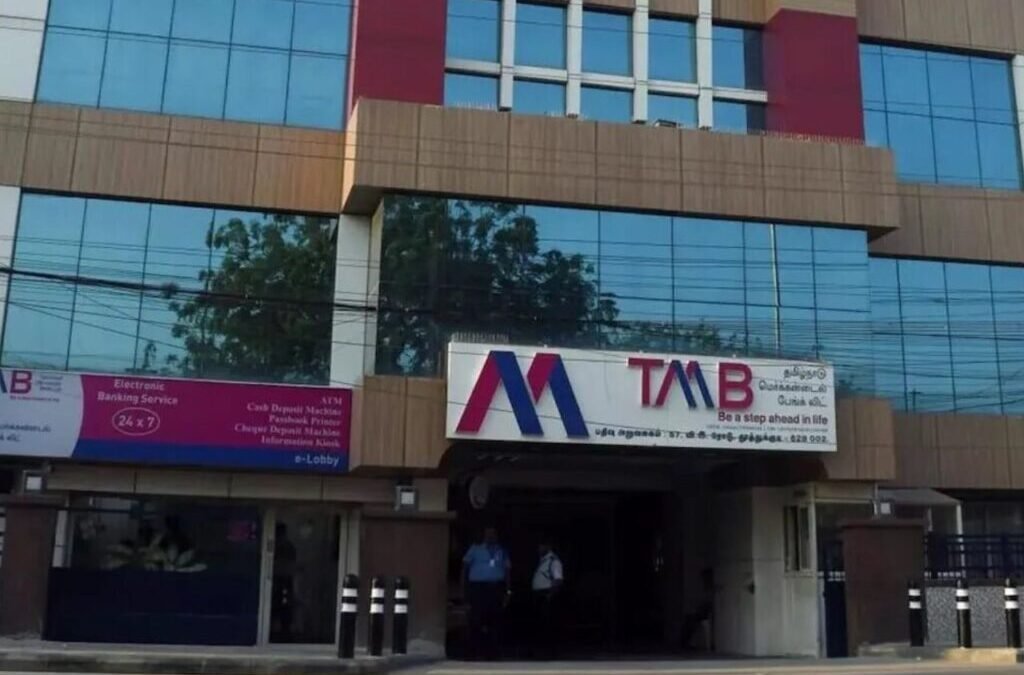
Synopsis: Tamilnad Mercantile Bank’s FY26 audited results, approved on April 27, 2026, deliver a clean sweep across the metrics that matter most for a regional private bank.
One of India’s oldest private sector banks filed its FY26 audited results on April 27, 2026, in a board meeting that ran from 11:00 AM to 1:20 PM. What emerged was among the most disciplined sets of numbers in the mid-cap banking space this results season.
With a market capitalisation of approximately Rs. 11,195.45 crore, shares of Tamilnad Mercantile Bank Limited (TMB) were trading at Rs. 706.35 per share, on a 52-week range of Rs. 411.80 to Rs. 721. The stock is trading at a P/E of 8.07.
Full-year net profit for FY26 rose 13.1 percent year-on-year to Rs. 1,337.55 crore from Rs. 1,182.61 crore in FY25. Total income for the year climbed 9.0 percent to Rs. 6,696.49 crore from Rs. 6,141.75 crore. The Q4 FY26 standalone performance was particularly sharp: quarterly net profit came in at Rs. 373.65 crore, up 28.0 percent from Rs. 291.90 crore in Q4 FY25, while operating profit for the quarter rose to Rs. 522.31 crore from Rs. 404.00 crore, a 29.3 percent jump.
The revenue composition tells a story of a retail-anchored bank growing consistently. Retail banking contributed Rs. 4,833.98 crore of the full-year segment revenue, accounting for 72.2 percent of total income, a franchise that is growing faster than wholesale or treasury. Retail segment profit before tax for FY26 came in at Rs. 1,344.56 crore, carrying the bank’s earnings with steadily improving efficiency.
Net interest income continued its upward trajectory, with interest earned on advances rising to Rs. 4,714.71 crore for the year from Rs. 4,246.18 crore, a 11.0 percent increase. The full-year net profit margin expanded to 19.97 percent from 19.26 percent in FY25.
This is where the filing genuinely stands out. TMB’s gross NPA ratio improved from 1.25 percent as of March 31, 2025 to 0.73 percent as of March 31, 2026, a reduction of 52 basis points in a single year. In absolute terms, gross NPAs fell from Rs. 556.13 crore to Rs. 388.21 crore.
Net NPA ratio halved from 0.36 percent to 0.18 percent. The Provision Coverage Ratio without technical write-off stood at 74.89 percent, up from 71.02 percent a year ago, and 96.14 percent including technical write-off indicating that the bank has adequately ring-fenced its stressed book.
For context, TMB continues to hold Rs. 250 crore in COVID-19 contingency provisions as of March 31, 2026, a buffer that has not been drawn down and adds a layer of implicit protection to the reported numbers.
Advances for the year grew 20.8 percent to Rs. 53,122.66 crore from Rs. 43,983.67 crore, a meaningfully faster pace than deposit growth, which rose 14.9 percent to Rs. 61,712.35 crore. The bank’s total balance sheet expanded to Rs. 75,299.60 crore from Rs. 66,449.87 crore, an increase of 13.3 percent. Net worth rose to Rs. 10,110.16 crore from Rs. 9,008.69 crore.
The Capital Adequacy Ratio under Basel III, at 33.73 percent, remains one of the highest in the Indian banking system for a bank of comparable size, roughly double the regulatory minimum. Common Equity Tier-1 ratio of 32.27 percent means the bank carries virtually no hybrid capital in its adequacy structure: everything sitting on the buffer is core equity. This creates significant headroom for future credit growth without needing to access capital markets.
One accounting change merits attention: TMB transitioned to accrual-based provisioning for variable pay, a shift from the earlier practice of booking incentive costs in the year of actual payment. As a result, the current year’s operating profit is Rs. 49.80 crore lower than it would have been under the old policy, with a corresponding increase in other liabilities. This is a one-time drag on reported operating profit and improves the quality of future earnings by matching costs to the periods that generate them.
The board recommended a final dividend of Rs. 12.50 per share for FY26, a 125 percent payout on the Rs. 10 face value up from Rs. 11 per share in FY25. The AGM date and record date will be announced in due course. At the April 15 price of Rs. 679.55, this implies a trailing dividend yield of approximately 1.84 percent, a respectable number for a bank growing at this pace.
Business Overview
Tamilnad Mercantile Bank Limited, incorporated on May 11, 1921 and renamed in 1962, is one of India’s oldest private sector banks. The Thoothukudi-headquartered bank provides retail banking, corporate and wholesale banking, treasury services, and foreign exchange operations across its network of over 622 branches. The bank’s loan book is heavily weighted toward retail, with MSME, agricultural, gold, home, and personal loans forming the core of its advances franchise.
Disclaimer: The views and investment tips expressed by investment experts/broking houses/rating agencies on tradebrains.in are their own, and not that of the website or its management. Investing in equities poses a risk of financial losses. Investors must therefore exercise due caution while investing or trading in stocks. Trade Brains Technologies Private Limited or the author are not liable for any losses caused as a result of the decision based on this article. Please consult your investment advisor before investing.
The post Tamilnad Mercantile Bank FY26 Profit Rises To 13% YoY; Dividend Raised to ₹12.5 appeared first on Trade Brains.