
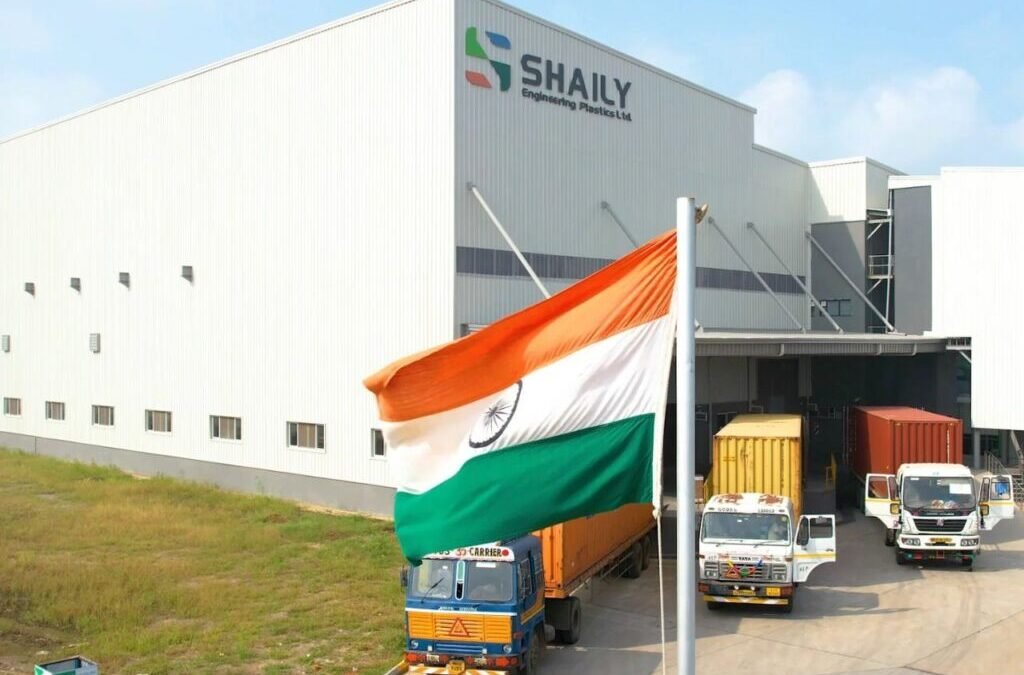
Synopsis: Shaily Engineering Plastics is rapidly emerging as a key player in the GLP-1 and semaglutide boom, but rising demand is beginning to test its capacity limits. With new expansions underway and global opportunities opening up, can Shaily scale fast enough to capture growth without hitting operational bottlenecks?
The weight loss drug boom is no longer just a pharmaceutical story. It is increasingly becoming a device manufacturing story as well, and that is where Shaily Engineering Plastics seems to be entering a very important phase. As demand for semaglutide and other GLP-1 therapies expands across markets such as Canada, India, Brazil, Turkey, and the Middle East, the company appears to be moving from being a contract manufacturer with a growing opportunity to becoming a key bottleneck solver in a market where device supply is still tight.
That also brings up the central question behind the Shaily story today: Is the company running out of capacity just when the opportunity is becoming real? Management commentary suggests that demand is already ahead of what the company can comfortably supply at this point, while new lines are still under qualification and a much larger Abu Dhabi expansion is still some time away. In simple terms, the opportunity looks large, customer interest appears strong, and contracts are coming in, but scaling up smoothly may be the biggest challenge over the next two years.
Healthcare Is Becoming the Core Growth Engine
One of the clearest signals from the latest quarter is how sharply the business mix is changing. In Q3, Shaily said the healthcare segment’s share in overall revenue doubled to 42 percent compared to last year. That is a major shift and shows that healthcare is no longer an emerging side business inside the company. It is becoming central to the company’s growth profile.
This change matters because Shaily’s current healthcare opportunity is tied not only to insulin or broader drug delivery products, but increasingly to pen injectors and auto-injectors used in therapies such as GLP-1s. The company also said it onboarded two new customers for GLP-1s and signed two new contracts with global pharma companies for pen injectors. One of these contracts is with an existing customer for a new project, while the other is with a completely new customer. That indicates both deeper wallet share with existing clients and fresh market entry with new ones.
The overall message from management was that the healthcare business is scaling quickly, and that the current momentum is not based on one isolated launch. It is being supported by a broader set of contracts, newer customer additions, and increasing global interest in pen-based drug delivery.
Demand Has Already Arrived, but Supply Is Still Catching Up
What makes the Shaily story interesting right now is that this does not look like a future-only opportunity. Management made it clear that supplies for commercial GLP-1 launches had already started in Q2FY26 for markets including Canada, Brazil, India, the Middle East, and Turkey. So this is not a case where the company is waiting for approvals with idle capacity sitting on hand. It is already supplying, but is struggling to meet the volume customers need because its high-speed line is still not fully operational.
That is perhaps the strongest evidence that capacity is becoming a real issue. Management openly said customers are “breathing down our necks” for supply. In other words, customer demand is ahead of the company’s current ability to deliver at full scale. The first new line is going through operational qualification and was expected to be completed shortly, after which supplies would move immediately. The second line is scheduled to arrive around the end of April or beginning of May 2026 and should be commercialized by the end of July 2026. Some commercial production is expected from March, but the proper scale-up is expected from April onward.
This timeline is important because it suggests that FY27 may still be a transition year rather than a year of full, smooth monetization. Even after the second line is up, management indicated it generally takes time to ramp a line from 50 to 60 parts per minute toward its intended 80 parts per minute. So the issue is not only installing capacity, but stabilizing it.
The company also acknowledged that qualification is proving more difficult than initially expected. What should have happened months ago is still ongoing because these are complex lines involving 25 to 30 operations, each of which has to be qualified individually and then together as one integrated system. At present, the line has been running at 60 to 70 parts per minute, but with high rejection rates of around 30 percent, not because of product quality, but because of machine settings. This is a highly operational challenge, not a demand challenge.
India Capacity Is Getting Tight
Whether Shaily is running out of capacity, the clearest answer from management is that India is certainly getting close to its practical limit. The company said it did not originally plan to add the 25 million pen line that is now coming in around April-May, but had to do so because building a full project outside India in less than 10 months was not feasible. So it chose to maximize India capacity in the interim.
More importantly, management said the company has no more building space and no more factory space left in India. That is a crucial point. It means further expansion in India is no longer an easy incremental filling up of existing facilities. Any additional capacity beyond what is already planned would likely require a new build.
The company’s current pen injector capacity in India stands at 80 million units per year. But even that number should not be read as capacity that can be fully sold at 100 percent utilization. Management explained that in this business, contracts usually include upside commitments of 20 percent to 25 percent, and manufacturers need buffer capacity to handle launches, seasonality, and unexpected spikes from one product or another. As a result, capacity is not meant to run fully loaded. A more realistic steady-state assumption is around 80 percent utilization.
This means that even when headline capacity seems comfortable, usable capacity can tighten very quickly when demand accelerates. Shaily also indicated that the India expansion is more or less fully backed by commercial contracts. That strongly suggests the upcoming lines are not speculative bets. They are being added because customer demand is already there.
Even then, management does not expect 70 percent to 80 percent utilization of the new India expansion in FY27. Instead, it suggested that such utilization is more realistic in FY28, because these products and lines simply take time to scale.
Abu Dhabi Is the Strategic Answer, Not Just an Expansion Project
To solve the capacity issue, Shaily has announced a much larger move: a new scalable facility in Abu Dhabi for pen injectors and auto-injectors. The planned investment is about AED130 million to AED150 million, or roughly Rs. 300 crore to Rs. 350 crore, for a facility with capacity of around 75 million units per year. It is expected to be operational by Q4 FY28.
Once this facility is added, total pen injector capacity would rise to 150 million units annually from the current 80 million. On the face of it, that seems like a large enough jump to support the next leg of growth. But the rationale goes beyond volume alone.
Management explained that Abu Dhabi offers multiple benefits. In healthcare, the company imports resin, equipment, and even key senior engineering talent. For expatriate talent coming from Asian countries, the personal income tax structure in the UAE is significantly more favorable than in India, making it easier and more economical to build teams there. The company also mentioned a business continuity angle. It said it had lost out on a very large contract a year ago because a customer saw risk in its clinical program due to geopolitical developments. That appears to have reinforced the need for a second manufacturing base outside India, especially for large global customers that do not want all supply concentrated in one geography.
There is also a technological difference. The Baroda facility currently runs a combination of 4-cavity, 8-cavity, and 16-cavity lines, with 16-cavity lines being used only for GLP-1 supply. In Abu Dhabi, the plan is to run only 16-cavity lines, which means the facility will be focused on high-speed, highly automated output from the start. Each such line can produce around 25 million to 28 million devices a year.
That said, Abu Dhabi is not fully de-risked yet. Management said around 50 percent to 60 percent of this expansion is secured through capacity commitments, with the expectation that it will be fully backed by contracts by the time it gets closer to commissioning. Funding is expected to come through a mix of internal accruals and debt, and the company is also in discussions with the Abu Dhabi government for possible financial support.
That said, the Abu Dhabi expansion also introduces a new layer of geopolitical risk that cannot be ignored. The recent tensions involving the United States, Israel, and Iran have already led to disruptions in parts of the Middle East, including airspace restrictions and logistical uncertainties. For a project that depends on imported equipment, global talent movement, and cross-border coordination, any escalation or prolonged instability in the region could lead to delays in execution timelines or cost overruns. While the strategic rationale for diversifying manufacturing outside India remains strong, the success of the Abu Dhabi facility will also depend on how stable the region remains over the next two years.
Pricing Pressure Exists, but Supply Still Looks Tight
One possible concern in a fast-growing market is whether competition could damage economics. Shaily did acknowledge pricing pressure and said there has been around 10 percent to 15 percent price erosion from the levels originally quoted for high-volume contracts. But management also made it clear that this erosion is lower than anticipated earlier.
The company’s view is that this pressure is not coming because supply is exceeding demand. It is happening because Shaily needs to support customers as they fight for market share in semaglutide. If its customers win more volume, Shaily wins more volume too. In that sense, device pricing is being used as part of the end-market competitive strategy.
Even so, management does not believe pricing is collapsing. It expects some further erosion in the first 24 months of supply, after which the market should stabilize. It also argued that the device remains the most complex part of the combination product, and that global pen capacity is still limited. Apart from a few new Chinese entrants that may be restricted to limited markets due to intellectual property concerns, management sees only a handful of serious global players in this area. That is why it does not expect a clear overcapacity scenario in the near term.
On margins, management suggested that once the business shifts toward larger, automated volumes, it should be able to maintain current pharma margins and may even improve them over time. For now, however, quarterly margins are being distorted by qualification delays, temporary expense increases, exhibitions, international setup activity, and delayed booking of certain milestone-based income.
So, Is Shaily Running Out of Capacity?
The simple answer is yes, but only in the near term and mostly in India. The company is already facing a situation where demand from GLP-1 customers is stronger than what its current operational lines can fully service. India has limited room left, the high-speed lines are still being stabilized, and the Abu Dhabi project will only come on stream by Q4 FY28. So the risk of capacity tightness over the next two years is real.
But that is only one side of the story. The more important point is that this capacity pressure appears to be the result of genuine demand, signed contracts, and a rapidly expanding healthcare business. Shaily is not scrambling to create demand for idle assets. It is racing to build enough supply for a market that is already asking for more.
That makes the real debate less about whether the opportunity exists and more about whether the company can execute the scale-up without losing time, customers, or economics. If it manages qualification smoothly, fills the India lines, and brings Abu Dhabi online without major delays, Shaily could move into a much larger league within drug delivery devices. But until then, capacity remains both its biggest growth lever and its biggest constraint.
At the same time, there is an external risk that could influence this entire execution timeline. With rising geopolitical tensions in the Middle East, particularly involving the United States, Israel, and Iran, the region has already seen disruptions in airspace, logistics, and overall stability. Since Shaily’s next phase of capacity expansion is heavily tied to Abu Dhabi, any prolonged conflict or escalation could delay project execution, disrupt equipment movement, or impact talent mobility. In a business where timing is critical and demand is already ahead of supply, even a few months of delay could meaningfully affect how much of the GLP-1 opportunity the company is able to capture.
Disclaimer: The views and investment tips expressed by investment experts/broking houses/rating agencies on tradebrains.in are their own, and not that of the website or its management. Investing in equities poses a risk of financial losses. Investors must therefore exercise due caution while investing or trading in stocks. Trade Brains Technologies Private Limited or the author are not liable for any losses caused as a result of the decision based on this article. Please consult your investment advisor before investing.
The post Shaily Engineering Plastics: Is It Running Out of Capacity Amid the Weight Loss Drug Boom? appeared first on Trade Brains.