
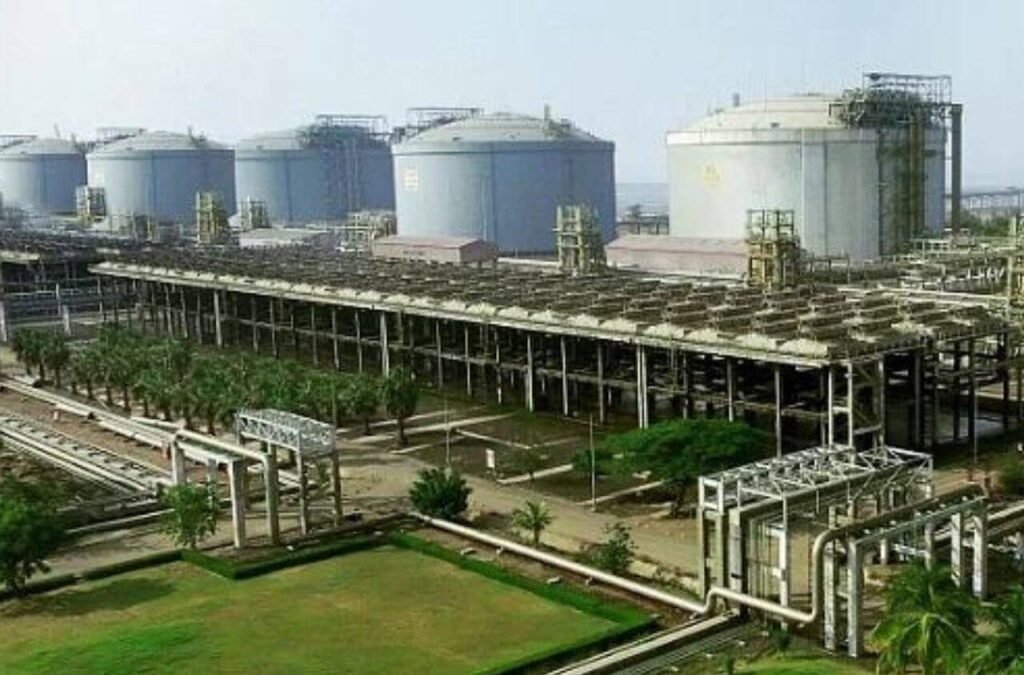
SYNOPSIS: Geopolitical tensions disrupt LNG supply, dragging volumes, earnings, and stock performance lower for this company, while brokerages cut estimates and targets, highlighting near-term risks and prolonged uncertainty despite limited visibility on recovery.
During Monday’s trading session, shares of a company commanding 43 percent of India’s LNG regasification capacity and managing around 2/3rd of the country’s LNG imports declined sharply, falling nearly 9 percent to hit a new 52-week low at Rs. 235.45 on BSE.
Price Movement
With a market cap of Rs. 35,677.5 crores, shares of Petronet LNG Limited are currently trading in the red at Rs. 237.85 on BSE, down by around 8 percent, compared to its previous closing price of Rs. 257.6. So far in 2026, the stock has delivered negative returns of over 17 percent, and has fallen by around 22 percent in the last month alone.
Since the onset of geopolitical tensions on 28th February 2026 (Saturday), which have weighed on global markets, the stock has struggled to maintain stability. From 2nd March (Monday) onwards, it has posted losses exceeding 23 percent and continues to trend downward.
Notably, this is shaping up to be its worst monthly performance since October 2008, when the stock had dropped 28 percent. With ongoing tensions in West Asia showing no signs of easing, the stock remains under sustained pressure.
Geopolitical Shockwaves: Why the LNG Player Is Under Pressure
Petronet LNG Limited has emerged as one of the most affected players amid the ongoing geopolitical tensions in the Middle East, primarily due to disruptions involving QatarEnergy, its key supplier.
QatarEnergy declared a Force Majeure following attacks on its Ras Laffan industrial complex, impacting nearly 17 percent of its total export capacity. The company has indicated that restoring the damaged infrastructure could take anywhere between 3-5 years, raising concerns over long-term supply disruptions. While Force Majeure has been invoked for certain international contracts, India has not been explicitly included in that list so far.
On 3rd March, Petronet LNG clarified that the ongoing conflict in the Middle East, particularly involving Iran and Israel, has disrupted shipping routes. LNG vessels are currently unable to safely pass through the Strait of Hormuz (a critical transit route) to reach Ras Laffan, which serves as the primary loading port for QatarEnergy.
Given the heightened security risks and challenges to maritime navigation, Petronet LNG issued Force Majeure notices for its LNG tankers, namely Disha, Raahi, and Aseem. In parallel, QatarEnergy also notified the company of a potential Force Majeure event due to the prevailing hostilities.
As a result, Petronet LNG has passed on similar Force Majeure notices to its off-takers, including GAIL (India) Limited, Indian Oil Corporation Limited, and Bharat Petroleum Corporation Limited, under their respective gas supply agreements dated 3rd March 2026.
Additionally, the company highlighted that war-related disruptions are not covered under its business interruption insurance policies, further intensifying the potential financial impact.
Brokerage Target and Outlook
Nomura has revised its outlook on Petronet LNG Limited, lowering its target price to Rs. 340 from Rs. 370, while maintaining a ‘buy’ rating on the stock, implying a potential upside of around 32 percent from its previous closing price. The downgrade reflects concerns over near-term volume disruptions arising from the ongoing West Asia crisis.
The brokerage highlighted that disruptions at QatarEnergy’s Ras Laffan LNG export facility are likely to weigh on volumes and earnings in the near term. The facility, with a capacity of 77 MTPA and contributing nearly 20 percent of global LNG trade, was placed under precautionary force majeure in early March.
According to Nomura, nearly 40 percent of Petronet LNG’s volumes are currently impacted. The situation has further intensified following Iran’s retaliatory strike on the Ras Laffan facility, raising the possibility of supply disruptions persisting for several months.
Additionally, commentary from QatarEnergy’s CEO suggests that two out of the 14 LNG trains have suffered long-term damage, potentially taking around 12.8 million tonnes, around 17 percent of total capacity, offline for a period of 3-5 years.
However, the brokerage noted a key positive: LNG trains dedicated to India have not been affected, based on discussions with the company’s management. This indicates that supplies to India could resume once the force majeure situation is resolved.
Factoring in the disruption, Nomura has reduced its FY27 volume estimates by 21 percent, assuming no supply from QatarEnergy for the next four months. It has not yet incorporated any impact from “use-or-pay” customers, which account for nearly 32 percent of capacity and are currently continuing at normal levels.
Reflecting these challenges, the brokerage has cut its EBITDA estimates by 11 percent for FY26 and 23 percent for FY27, expecting a gradual recovery as the Ras Laffan facility takes time to return to normal operations.
On the positive side, some of the earnings pressure may be offset by a 5 percent increase in regasification tariffs effective January 2026. Despite this, Nomura has lowered its discounted cash flow-based valuation to Rs. 340, while keeping its weighted average cost of capital (WACC) unchanged at 12 percent.
At current levels, the stock is trading at around 11.7x FY27 estimated earnings and 1.8x book value, both close to one standard deviation below historical averages, suggesting that valuations remain relatively attractive despite near-term headwinds.
Financials & More:
Petronet LNG reported a marginal decline in revenue from operations, experiencing a year-on-year decrease of around 9 percent, from Rs. 12,227 crores in Q3 FY25 to Rs. 11,164 crores in Q3 FY26. Likewise, its net profit decreased during the same period from Rs. 902 crores to Rs. 870 crores, representing a decline of about 4 percent YoY.
Petronet LNG Limited (PLL) is a joint venture promoted by four Oil & Gas Maharatna PSUs: GAIL, ONGC, IOCL, and BPCL, each holding a 12.5 percent equity stake. It was formed to develop, design, construct, own and operate Liquefied Natural Gas (LNG) Import and regasification terminals in India
With its two LNG regasification terminals at Dahej (Gujarat) and Kochi (Kerala), the company has a total regasification capacity of 22.5 MMTPA. It is further augmenting Dahej terminal capacity from 17.5 MMTPA to 22.5 MMTPA, which is likely to be commissioned shortly.
Further, PLL is also in the process of setting up a land-based greenfield LNG regasification terminal of 5 MMTPA capacity on the East Coast of India at Gopalpur (Odisha). PLL is also setting up a 750 KTA PDH and 500 KTA PP unit, including ethane and propane handling facilities at Dahej (Gujarat).
The company is currently facing near-term challenges driven by geopolitical disruptions affecting supply chains and volumes. However, the impact appears largely cyclical rather than structural, with operations expected to normalise once tensions ease. While earnings visibility remains uncertain in the short term, stable long-term demand fundamentals and reasonable valuations provide some support to the overall outlook.
Disclaimer: The views and investment tips expressed by investment experts/broking houses/rating agencies on tradebrains.in are their own, and not that of the website or its management. Investing in equities poses a risk of financial losses. Investors must therefore exercise due caution while investing or trading in stocks. Trade Brains Technologies Private Limited or the author are not liable for any losses caused as a result of the decision based on this article. Please consult your investment advisor before investing.
The post Petronet LNG: What the Energy Crisis Means for the Company’s Financial Performance Ahead appeared first on Trade Brains.