
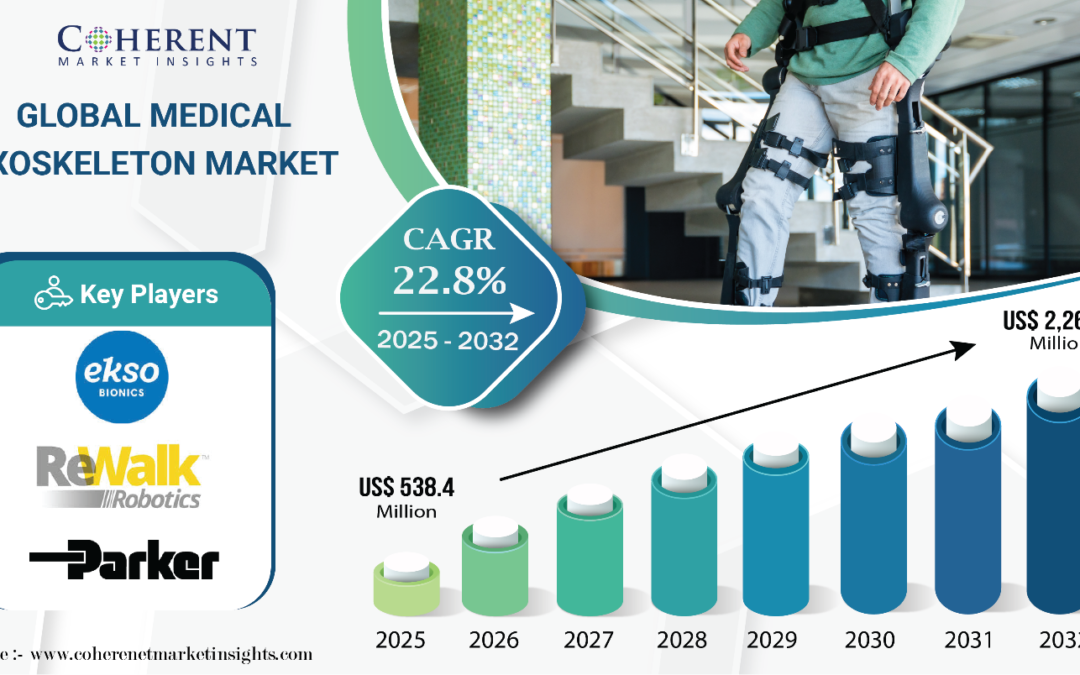
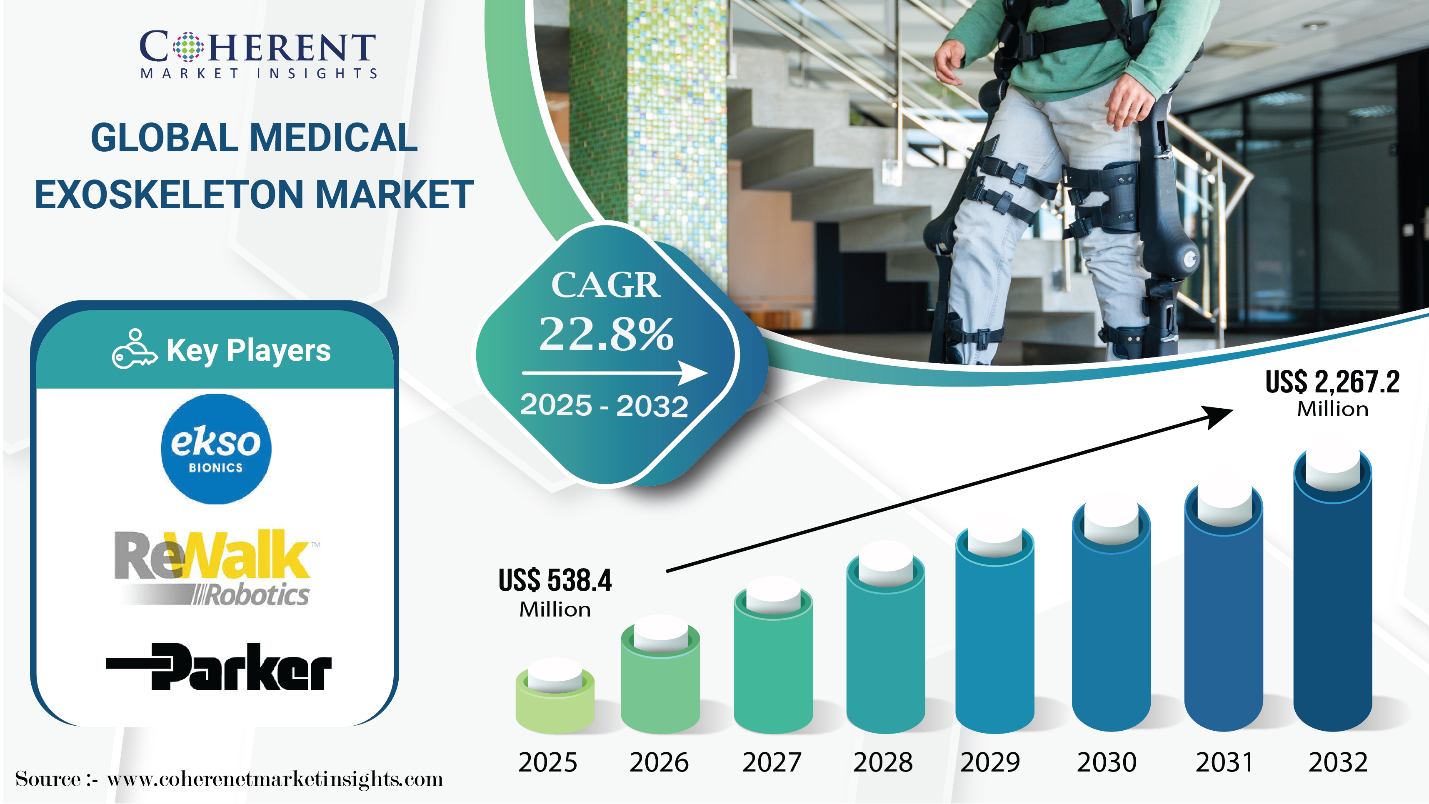
Burlingame, CA, July 02, 2025 (GLOBE NEWSWIRE) — The Global Medical Exoskeleton Market is estimated to be valued at USD 538.4 Mn in 2025 and is expected to reach USD 2,267.2 Mn in 2032, exhibiting a compound annual growth rate (CAGR) of 22.8% from 2025 to 2032. Medical exoskeletons are wearable systems designed to support movement and enhance physical strength. These devices assist individuals with mobility challenges such as muscle weakness or spinal injuries in walking, standing, lifting, and participating in rehabilitation or work-related tasks. Market growth is fueled by the rising number of spinal cord injuries, increasing orthopaedic conditions, and the expanding elderly population.
Request Sample Report: https://www.coherentmarketinsights.com/insight/request-sample/6489
Global Medical Exoskeleton Market Key Takeaways
According to Coherent Market Insights (CMI), the global medical skeleton market size is expected to grow more than fourfold, from USD 538.4 Mn in 2025 to USD 2,267.2 Mn by 2032.
Global demand for medical exoskeletons is anticipated to increase at a prolific CAGR of 22.8% during the forecast period.
Based on type, lower body exoskeletons segment is expected to dominate the industry, holding a market share of 43.2% in 2025.
North America is projected to account for nearly two-fifths of the global medical exoskeleton market share in 2025.
Europe medical exoskeleton market is estimated to be valued at around USD 150. 75 Mn by 2025.
Asia Pacific is poised to record fastest growth during the assessment period. This is due to rising incidence of mobility impairments and disabilities, as well as increasing acceptance and adoption of medical exoskeletons.
Get Instant Access! Purchase Research Report and Receive a 25% Discount: https://www.coherentmarketinsights.com/insight/buy-now/6489
Rising Prevalence of Disabilities and Neurological Disorders Fueling Market Growth
Coherent Market Insights’ latest global medical exoskeleton market research report provides insights into key factors driving the industry’s growth. One such key growth driver is the increasing incidence of neurological disorders and physical disabilities.
According to the World Health Organization (WHO), over 3 billion people worldwide are living with a neurological condition. This rise in neurological disorders like stroke, multiple sclerosis, Parkinson’s disease, and cerebral palsy is expected to boost demand for medical exoskeletons.
Medical exoskeletons are designed to assist or enhance human movement. They have the tendency to support rehabilitation by assisting weakened muscles. These wearable mechanical devices consist of structural components, control systems, sensors, motors, and actuators that work together to mimic human motion.
High Cost and Regulatory Hurdles Limiting Market Growth
The global medical exoskeleton market outlook indicates strong future growth. However, high cost of medical exoskeletons and regulatory challenges are expected to limit market expansion to some extent.
Advanced medical exoskeletons are quite expensive, costing thousands of dollars. This high cost deters patients with disabilities from opting for medical exoskeletons, leading to reduced market demand.
Similarly, medical exoskeletons must undergo rigorous and often lengthy regulatory approval processes. These processes can delay product launches and increase development costs, potentially …