
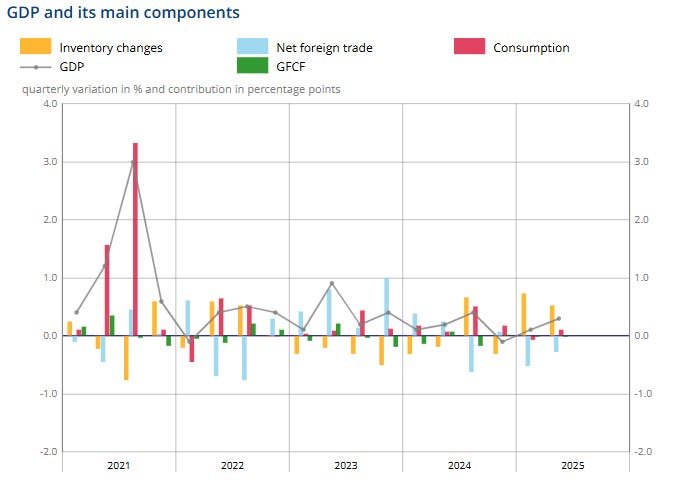
The French economy recorded marginal economic growth in the second quarter of the year as the government navigated another political crisis over its looming debt crisis.
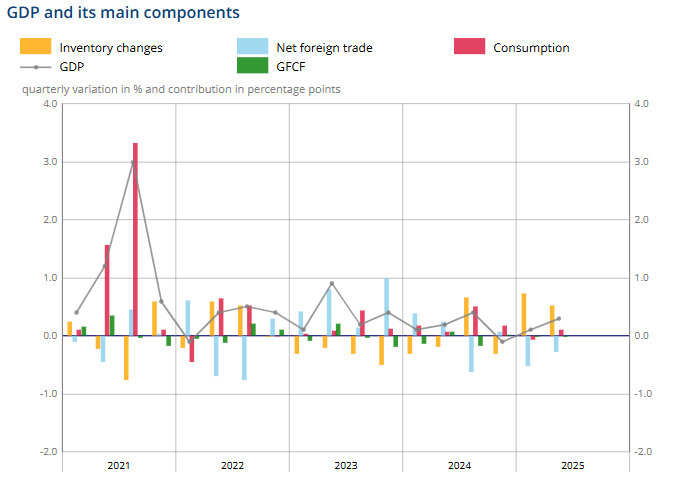
Real gross domestic product (GDP) rose in the second quarter of 2025 by 0.3% after a 0.1% gain in the previous quarter, data from the country’s National Institute of Statistics and Economic Studies showed today. However, net foreign trade fell 0.3% in the quarter, compared with a 0.5% decline in the first quarter.
Personal spending in France decreased 0.30% in July over the previous month, government data showed. As a result, consumer confidence fell to 87 in August, down from 88 in the last three months and below forecasts of 90.
The lackluster economic data comes as the government of French President Emmanuel Macron teeters on the brink of collapse, potentially leaving it unable to tackle its ballooning national debt and counter anemic growth. French Prime Minister Francois Bayrou called on Monday for a confidence vote in an effort to end a political deadlock over the country’s debt.
The political crisis in Europe’s second-largest economy has become an economic liability as investors and institutions watch how Macron navigates the latest setback. Opinion polls following Bayrou’s announcement showed that most French people want new national elections, indicating a deepening dissatisfaction with politics.
French Finance Minister Warns of Possible IMF Bailout
Finance Minister Eric Lombard said on Tuesday that France risks seeking a bailout from the Washington-based International Monetary Fund (IMF). The “risk” of an IMF intervention is “in front of us,” Lombard said in an interview with France Inter radio.
“It is a risk that we would like to avoid, and one that we should avoid, but I cannot tell you that this risk does not exist.”
Michael A. Arouet, an economist and political analyst, warned that the second “Euro crisis” will start in France. “It will be about trillions,” he posted on X on Thursday.
The IMF and the European Union (EU) intervened in the first Euro crisis in 2008, fearing …