
Austin, TX, USA, May 06, 2025 (GLOBE NEWSWIRE) — Custom Market Insights has published a new research report titled “Firefighting Foam Market Size, Trends and Insights By Type (Aqueous Film Forming Foam (AFFF), Alcohol Resistant Aqueous Film Forming Foam (AR-FFF), Protein Foam (PF), Synthetic Detergent Foam (Medium and High Expansion)), By Application (Oil & Gas, Aviation, Marine, Mining, Warehouse, Others), By Fire Type (Class A, Class B, Class C), and By Region – Global Industry Overview, Statistical Data, Competitive Analysis, Share, Outlook, and Forecast 2025 – 2034“ in its research database.
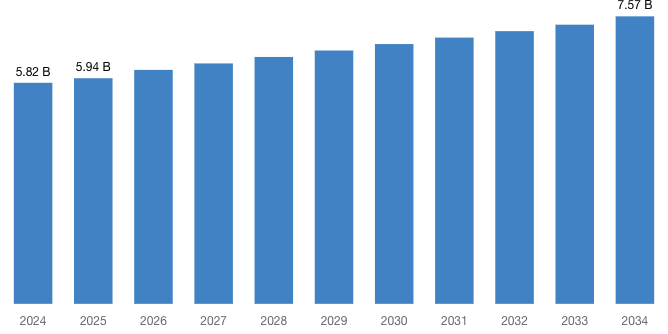
“According to the latest research study, the demand of the global Firefighting Foam Market size & share was valued at approximately USD 5.82 Billion in 2024 and is expected to reach USD 5.94 Billion in 2025 and is expected to reach a value of around USD 7.57 Billion by 2034, at a compound annual growth rate (CAGR) of about 2.7% during the forecast period 2025 to 2034.”
Click Here to Access a Free Sample Report of the Global Firefighting Foam Market @ https://www.custommarketinsights.com/request-for-free-sample/?reportid=18854
Firefighting Foam Market Overview
As per the industry experts at CMI, the Firefighting Foam market majorly depends on the increasing rate of structural and industrial fires, stringent fire safety regulations, and expansion in oil & gas and chemical industries. The demand for firefighting foams in high-hazard industries has risen due to increasing investments in industrial infrastructure and the need for effective fire suppression systems.
Additionally, growing awareness of compliance with fire safety standards, particularly in commercial aviation, marine vessels, and petrochemical plants, is also driving market growth. Advances in eco-friendly, fluorine-free foams, spurred by regulatory limitations on PFAS-based solutions, are also transforming product development strategies. The market will find growth momentum through government firefighting efforts, refurbishment of aged facilities, and growing procurement of sophisticated fire protection systems worldwide.
Firefighting Foam Market Growth Factors and Dynamics
- Industrial Expansion in Emerging Economies: The rapid industrialization throughout the emerging markets of India, China, Brazil, and countries in Southeast Asia is building immense demand for firefighting foams. These countries are all facing tremendous growth within the oil & gas, petrochemical, manufacturing, and transportation industries, which are all critically susceptible to being exposed to fires. As governments promote foreign direct investment (FDI) and infrastructure development, the demand for robust fire protection systems in industrial factories is increasing. Firefighting foam is a sought-after medium due to its ability to suppress and blanket fires at a rapid rate. Additionally, urbanization and industrial parks in these nations demand adherence to international fire safety standards, driving the adoption of firefighting foam solutions. As these economies grow, the associated demand for industrial fire protection products, including foam-based products, will increase, providing a primary growth avenue for manufacturers.
- Advancements in Foam Formulations: The foam industry for firefighting is experiencing universal innovation in foam chemistry because of increasing regulatory and environmental pressure to move away from hazardous chemicals such as per- and polyfluoroalkyl substances (PFAS). Industry is meeting this challenge with greater research and development activity to create high-performance, fluorine-free replacement foams with similar or improved fire suppression effectiveness compared to legacy aqueous film-forming foams (AFFF). These advancements are reshaping product portfolios and positioning eco-friendly foams as the future standard in both municipal and industrial fire safety applications. These newer products are designed to extinguish fire rapidly, but with less toxicity and greater biodegradability, in line with global patterns toward lower environmental impact and regulation. For example, In May 2023, Johnson Controls introduced the NFF-331 3%x3% Concentrate, a non-fluorinated firefighting foam. This moves with the industry’s trend toward green products, countering the issue of PFAS in conventional foams. In addition, new foams are designed to possess longer shelf lives, reduced viscosities for improved pumpability, and greater compatibility with current delivery systems. These developments minimize environmental impact and create new markets where conventional foams have been prohibited, making them a significant force behind market growth.
Request a Customized Copy of the Firefighting Foam Market Report @ https://www.custommarketinsights.com/request-for-customization/?reportid=18854
- Rising Awareness of Fire Safety: Global consciousness for occupational safety and disaster risk management is increasingly on the rise, particularly in industrial, commercial, and public infrastructure settings. Governments and institutions are implementing stricter fire protection codes demanding effective suppression systems, thus creating a positive market for firefighting foams. Campaigns, programs for training, and more stringent audits under organizations like the National Fire Protection Association (NFPA) in the United States or comparable organizations in Europe and Asia-Pacific are compelling industries to invest in dependable firefighting systems. These include foam systems, which provide better performance in dealing with Class A and B fires. Moreover, companies are preferring preventive solutions over reactive solutions, promoting proactive installation of foam-based fire suppression systems. The overall effect of rising consciousness and governmental support is the direct consequence of growing adoption and demand for firefighting foams worldwide.
- Expansion in Oil & Gas Industry: The oil and gas sector is one of the biggest and most combustible sectors in the world and is hence one of the biggest consumers of firefighting foam systems. Offshore and onshore production and exploration activities demand special foam solutions that would be able to quickly and safely extinguish fires involving flammable liquids. The continued rise of the market, especially in the Middle East, North America, and Asia-Pacific, is fueling the demand for high-performance foams such as AFFF and AR-AFFF. These foams are necessary to fight hydrocarbon pool fires and avoid re-ignition. Oil terminal, refinery, storage tank, and LNG facility regulatory requirements fuel the addition of fixed and portable foam systems. Also, as companies refurbish their safety equipment and replace old equipment, there will be increased need for technologically advanced and eco-friendly firefighting foams, which will be an effective market growth driver.
Report Scope
| Feature of the Report | Details |
| Market Size in 2025 | USD 5.94 Billion |
| Projected Market Size in 2034 | USD 7.57 Billion |
| Market Size in 2024 | USD 5.82 Billion |
| CAGR Growth Rate | 2.7% CAGR |
| Base Year | 2024 |
| Forecast Period | 2025-2034 |
| Key Segment | By Type, Application, Fire Type and Region |
| Report … |