
Austin, TX, USA, Sept. 22, 2025 (GLOBE NEWSWIRE) — Custom Market Insights has published a new research report titled “Electric Hoist Market Size, Trends and Insights By Type (Chain, Wire), By Application (Commercial Recovery, Cranes, Workboat, Utility, Others), By Industry Vertical (Aerospace, Automotive & Transportation, Construction, Energy, Others), and By Region – Global Industry Overview, Statistical Data, Competitive Analysis, Share, Outlook, and Forecast 2025 – 2034“ in its research database.
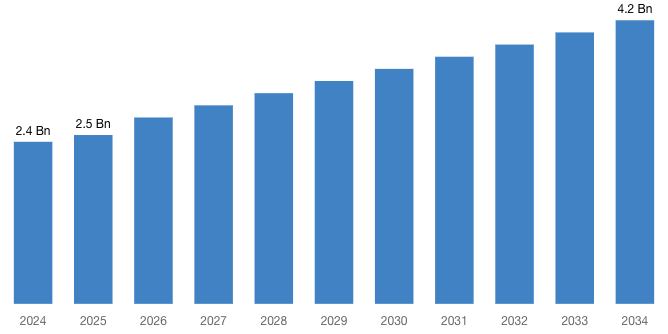
According to the latest research study, the global Electric Hoist Market size and share were valued at approximately USD 2.4 billion in 2024, are expected to reach USD 2.5 billion in 2025, and are projected to grow to around USD 4.2 billion by 2034, with a compound annual growth rate (CAGR) of about 5.7% during the forecast period from 2025 to 2034.
Click Here to Access a Free Sample Report of the Global Electric Hoist Market @ https://www.custommarketinsights.com/request-for-free-sample/?reportid=73580
Overview
According to industry experts at CMI, A lot of firms utilize electric hoists to make it easier to lift and transport heavy goods. An electric hoist has a motor that moves things up and down with a chain or wire rope. The technology is easy to use and very accurate. It can also handle challenging chores that would normally take a lot of work. They can use a switch or a remote to turn it on and off.
The goal of these hoists is to help workers do more, feel less worn out, and be safer at work in general. The electric hoist market is being driven by several variables, such as the growing e-commerce sector, increasing safety regulation, growing trends of automation across industry, increasing demand from the renewable energy sector, and others. However, the complexity of integration and standardization presents a significant challenge to market growth.
Key Trends & Drivers
- E-commerce and logistics boom: The rising e-commerce and logistics industry is a significant driver for the electric hoist market. A growing number of individuals are shopping online at sites like Amazon, Alibaba, Walmart, and FedEx. This demands automated warehouses and logistical infrastructure. Luckily, technology has made it possible to employ electric hoists to carry objects efficiently and conveniently. The warehousing industry is vast and rapidly expanding. The European Materials Handling Federation reports that demand for automated warehouse lifting systems has gone up 34% per year since 2023. The main reason for this surge was growth in logistics and online shopping. As logistics operations become more complex, there is a growing need for IoT-enabled hoists that can do things like monitor in real time, predict when maintenance will be needed, and analyze data. The aforementioned facts drive the market.
Request a Customized Copy of the Electric Hoist Market Report @ https://www.custommarketinsights.com/request-for-customization/?reportid=73580
- Emphasis on safety and ergonomics: Increasing emphasis on safety and ergonomics is what is driving the market revenue. Electric hoist equipment is equipment that allows the worker to raise objects automatically without their need, which minimizes the risk of musculoskeletal disorders (MSDs) such as back discomfort, strains, and sprains. They make the workplace safer and better for workers by taking the hard labor out of lifting heavy things. This makes workers less stressed and exhausted. Operators may also stay awake and learn more easily because the handles can be adjusted, the controls are simple, and they can use a remote or joystick. Quiet and compact versions are especially useful in busy or sensitive places because they make things more comfortable and easier to reach.
Report Scope
| Feature of the Report | Details |
| Market Size in 2025 | USD 2.5 Billion |
| Projected Market Size in 2034 | USD 4.2 Billion |
| Market Size in 2024 | USD 2.4 Billion |
| CAGR Growth Rate | 5.7% CAGR |
| Base Year | 2024 |
| Forecast Period | 2025-2034 |
| Key Segment | By Type, Application, Industry Vertical and Region |
| Report Coverage | Revenue Estimation and Forecast, Company Profile, Competitive Landscape, Growth Factors and Recent Trends |
| Regional Scope | North America, Europe, Asia Pacific, Middle East & Africa, and South & Central America |