
Austin, TX, USA, Sept. 11, 2025 (GLOBE NEWSWIRE) — Custom Market Insights has published a new research report titled “Artificial Womb Facility Market Size, Trends and Insights By Technology (Bioreactors, Extrauter in Support Devices, Others), By Application (Prenatal Care, Neonatal Care), By End User (Super Specialty Hospitals, Research Centers, In-Vitro Fertilization Centers (IVF)), and By Region – Global Industry Overview, Statistical Data, Competitive Analysis, Share, Outlook, and Forecast 2025 – 2034“ in its research database.
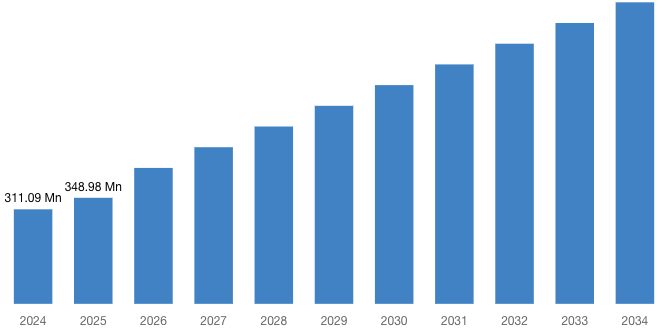
According to the latest research study, the global Artificial Womb Facility Market size and share were valued at approximately USD 311.09 million in 2024, are expected to reach USD 348.98 million in 2025, and are projected to grow to around USD 992.36 million by 2034, with a compound annual growth rate (CAGR) of about 12.31% during the forecast period from 2025 to 2034.
Click Here to Access a Free Sample Report of the Global Artificial Womb Facility Market @ https://www.custommarketinsights.com/request-for-free-sample/?reportid=72687
Overview
According to experts at CMI, manufacturers using new strategies and technologies will create great chances for businesses in the Artificial Womb Facility Market in the coming years. Furthermore, we expect the growing significance of organized retailing to drive the future growth of the market.
Key Trends & Drivers
- Integration of AI and IoT in Artificial Womb Systems: Artificial Womb Systems increasingly employ AI and IoT to ascertain health parameters in fetuses and automatically execute various system functions. AI-based algorithms use inputs such as oxygenation levels, nutrient supply, and growth assessment on a real-time basis for ensuring near-perfect accuracies and to provide an optimized environment for the gestational process. IoT-enabled devices support remote monitoring and intervention, thereby reducing the need for constant manual intervention. The predictive analytics aspect of the technology also alerts of any adverse realization and compensatory measures to avert crisis scenarios, thereby improving safety outcomes. This trend increases efficiency and reduces human error, making artificial womb systems more reliable. As the healthcare industry moves towards automation and data-driven care, this integration of AI and IoT is set to become a demarcating trend for the market.
- Growing Focus on Neonatal Care Innovations: The premature birth remains a global challenge, which increases the demand for advanced neonatal care solutions. Traditional incubators fail to mimic the complexity of the womb environment and so cannot support the extremely preterm babies. Artificial wombs fill this gap by providing fluid environments coupled with controlled nutrient and oxygen delivery to allow appropriate organ development. Innovations in neonatal care are increasingly focusing on safety, adaptability, and long-term health outcomes, making artificial wombs a transformative tool. Research institutions and hospitals are encouraging this technology so that it could be implemented to save the lives of babies, thereby setting neonatal care innovation as an enabler and major trend impacting the adoption and further development of artificial womb systems.
- Expansion of Assisted Reproductive Technologies (ART): The increase in the usage of ART, such as IVF, is expected to create an opportunity for artificial womb technology to become an integral part of reproductive healthcare. Many couples, individuals, or families experience it difficult to carry pregnancies to term due to considerations of medical issues, age, or lifestyle. In contrast to surrogacy, artificial wombs address various legal and ethical concerns and thereby increase success rates in biological parenthood. This trend correlates with increasing levels of infertility and delayed parenthood worldwide. Fertility clinics are progressively planning to use artificial wombs, so ART expansion stands as a major opportunity for marketing drives in its embrace.
- Ethical and Regulatory Framework Development: As there has been advancement in the artificial womb technology, the regulatory and ethical authorities are intimately involved in charting a clear course for the utilization of this technology. This trend is concurrent with a mounting realization of the need to provide due consideration to safety, clinical trials, and patient rights to ensure responsible introduction in practice. Countries that have more progressive healthcare policies take the lead in striking a balance between innovation and societal values. Transparent ethical principles thus promote public trust and lessen public opposition to such a radical technology. Those ethical and regulatory guidelines also serve to mitigate many of the uncertainties, making it risky for private investors to put their money in artificial womb technology. The urgent focus put on the question of ethics and legality will thus provide a way forward for the upscaling of artificial womb technology and achieving mass acceptance and compliance.
Request a Customized Copy of the Artificial Womb Facility Market Report @ https://www.custommarketinsights.com/request-for-customization/?reportid=72687
- Collaborative Between Research Institutes and Healthcare Providers: The partnership between the academic research institutions, biotech companies, and hospitals is increasing the development and clinical validation of the artificial womb technology. The research institutes provide innovation and technical expertise, while the healthcare providers offer real-world clinical environments for testing and adoption. Such collaborations enable the integration of technology into neonatal and fertility care pathways. On a growing basis, such demand for multi-disciplinary expertise, with biotechnology, bioengineering, and reproductive medicine at the forefront, lays collaborative models as one of the core trends in fostering innovation, regulatory acceptance, and eventual commercialization of artificial womb facilities worldwide.
- Rising Interest in Space Exploration and Extreme Environments: An artificial womb, more than its medical usage, is slowly becoming a subject of interest as a law of maintaining human life contingent upon space and another cruel environment. Long-duration space missions and extra-terrestrial colonization are working towards searching for possible parents capable of reproductive processes and population maintenance in the absence of Earth-like conditions. The artificial womb systems can cater to these problems by enabling the controlled gestation outside the human body while controlling for bad environmental factors and microgravity. The space agencies along with the private aerospace firms are now looking into the possibility of joining forces with biotech companies to advance such technologies. Such an outlook provides an alternative avenue to the market’s growth track, attracting funding and research interest from defense and space exploration sectors.
Report Scope
| Feature of the Report | Details |
| Market Size in 2025 | USD 348.98 Million |
| Projected Market Size in 2034 | USD 992.36 Million |
| Market Size in 2024 | USD 311.09 Million |
| CAGR Growth Rate | 12.31% CAGR |
| Base Year | 2024 |
| Forecast Period | 2025-2034 |
| Key Segment | By Technology, Application, End User and Region |
| Report Coverage | Revenue Estimation and Forecast, Company Profile, Competitive Landscape, Growth Factors and Recent Trends |
| Regional Scope | North America, Europe, Asia Pacific, Middle East & Africa, and South & Central America |
| Buying Options | Request tailored … |