
Synopsis: As Paytm, Swiggy, Meesho, and PhysicsWallah scale rapidly across India’s consumer-tech landscape, a critical question looms: can growth translate into sustainable pricing power before investors lose patience? Despite expanding user bases and rising revenues, profitability remains elusive. This article examines whether these companies are building durable, value-creating businesses, or deferring costs into the future.
How Deep Are the Losses?
Looking at the topline, the companies are growing at staggering rates. Some companies have even managed to reduce losses and start generating EBITDA profit; yet, the losses of just five companies (Meesho, Swiggy, Physicswallah, Paytm, and Brainbees Solution) exceed Rs 7,500 crore in just FY25.
Meesho: It is a multi-sided e-commerce marketplace that connects consumers, sellers, logistics partners, and content creators through its app-based platform. It grew its revenue at a 27.96% CAGR since FY23, while losses stood at Rs 3,942 crore in FY25 (vs loss of Rs 1,672 crore in FY23). Although the losses in FY25 are due to one-time exceptional items such as tax incurred for reorganisation and ESOP expenses, amounting to Rs 1,346 crore. Despite these exceptional items, in H1FY26 the company incurred a loss (PBT) of Rs 571 crore and an adjusted EBITDA loss of Rs 551.87 crore. Meesho’s stock made a stellar debut on December 10, 2025, soaring 53.23% on its listing day. The momentum has hardly faded since then, as it rallied further to gain 94.91% from its issue price.
Yet, beneath the euphoria, valuation concerns loom large. The stock now trades at a price-to-sales multiple of 10.33x, significantly higher than its listed peers. While Meesho’s 43% CAGR in sales growth over the past three years highlights its rapid scale-up and market traction, the soaring valuation appears to be worrisome. For now, investors seem willing to pay a steep premium for growth, but that optimism may face a reality check if earnings fail to keep pace.
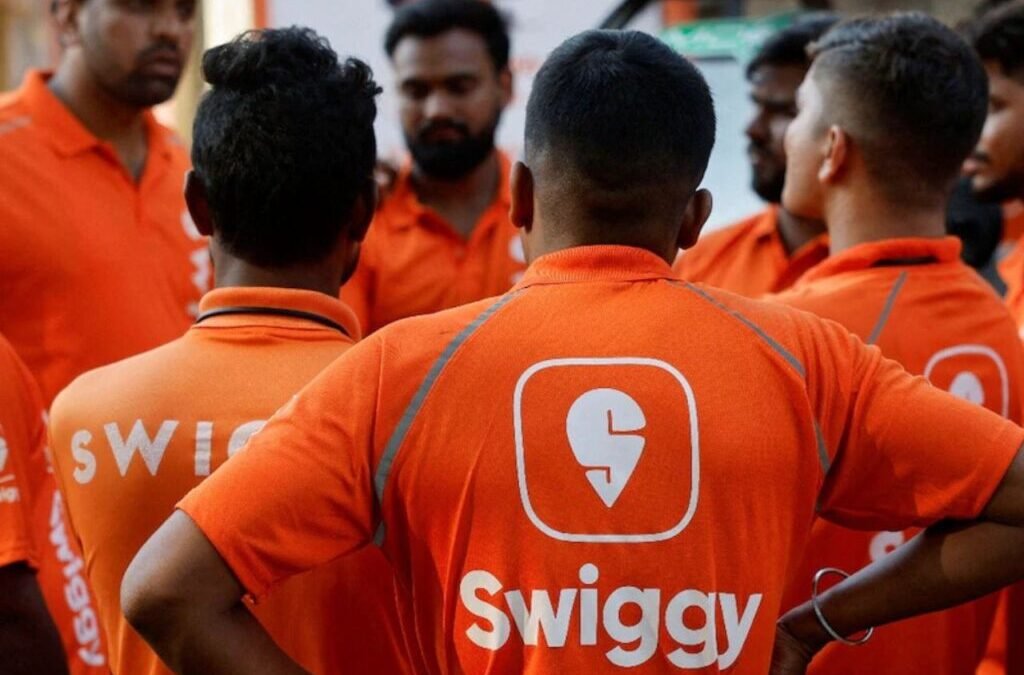
Swiggy: It has pioneered the hyperlocal commerce industry in India, launching Food Delivery in 2014 and Quick Commerce in 2020. It grew its revenue at an astounding CAGR of 38.7% since FY22, whereas losses stood at Rs 3,117 crore in FY25 (vs loss of Rs 4,179 crore in FY23). Moreover, in Q2FY26, the company incurred a loss (PBT) of Rs 1,092 crore and an adjusted EBITDA loss of Rs 695 crore. Swiggy’s listing on November 13, 2024, ignited brief market enthusiasm with a 16.92% surge on debut day, but the food delivery pioneer’s post-IPO trajectory has since turned sharply sour.
Trading at a premium price-to-book ratio of 10.18x, well above competitor Eternal, the stock’s valuation overlooks glaring underperformance, including sales growth of 39% CAGR over the past three years, lagging behind Eternal’s stronger pace in the same period. This mismatch between lofty multiples and middling expansion has fueled investor jitters, culminating in a steep 35.19% decline over the past year.
Physicswallah: It is a leading Indian edtech company that provides test preparation courses for competitive examinations such as JEE, NEET, and UPSC, along with various upskilling and foundational learning programs. Revenue witnessed an astounding growth at a CAGR of 96.93% since FY23, whereas losses stood at Rs 243 crore in FY25 (vs loss of Rs 84 crore in FY23). However, the company reported a profit of Rs 69.7 crore in Q2FY26 and a free cash flow of Rs 644.1 crore for H1FY26, compared to Rs 543.4 crore in H1FY25.
It’s big IPO launch on November 18, 2025, grabbed attention, with shares jumping 42.42% on the listing day. It stands alone as the only ed-tech firm listed on the stock market right now. Trading at a high price-to-sales ratio of 12.94x, this premium price raises questions about valuations.
One 97 Communications: It is India’s leading mobile payments and financial services distribution company. It grew its revenue at a moderate growth of 11.5% CAGR since FY23, mainly due to selling the entertainment business. It has successfully reduced the loss from Rs 2,396 crore in FY22 to Rs 663 crore in FY25. Moreover, the company generated a PAT of Rs 21 crore as of Q1FY26, which includes the exceptional item of Rs 190 crore, and EBITDA improved to Rs 142 crore, with an EBITDA margin of 7%.
One97 Communications was listed on 18th November 2021, which fell -27.4% on the listing day. Despite robust gross merchandise value growth at a 57% CAGR since FY21, the stock lingers at a price-to-sales multiple of 10.69x, commanding a premium over Bajaj Finance, the industry’s trailblazing giant trading at 8.15x. This valuation mismatch highlights the risks of betting big on fintech disruption when profitability remains elusive in a maturing lending landscape.
Growth beyond financial numbers
When evaluating loss‑making platforms, financial metrics may not alone tell a complete story. The real growth of the company lies in operational KPIs that reveal whether a company is building a durable competitive advantage or merely renting engagement through subsidies. For consumer marketplaces and fintech, the critical metrics are: Gross Merchandise Value (GMV) or transaction volume growth; Monthly Active Users (MAU) and daily active users (DAU) as proxies for habit formation; customer acquisition cost (CAC) relative to lifetime value (LTV); cohort retention and repeat transaction frequency; and increasingly, contribution margin (revenue minus direct variable costs) on a per‑transaction or per‑user basis.
Meesho: Meesho platform witnessed 13.53 billion Average Daily Product Views as of FY25, whereas as of H1FY26, it stood at 16.61 billion (vs 12.40 billion as of H1FY25). Annual Transacting Users data helps to assess the depth and engagement of seller base count, which stood at 234.20 million as of H1FY26 (vs 175.09 million as of H1FY25), whereas the number of unique products purchased per transaction stood at 1,261.14 million as of H1FY25, up by 52.94%. Gross Merchandise Value stood at Rs 334.83 billion in H1FY26 (vs Rs 226.09 billion in H1FY25), indicating rising repeat purchases and higher baskets. Meesho Mall aims to boost average order value and ad monetisation. India’s e-commerce GMV is set to nearly triple to Rs 15-18 trillion by FY30, giving Meesho’s affordable assortment a long growth runway.
Swiggy: Company has a B2C GOV of Rs 16,683 crore as of Q2FY26, up by 47.6% YoY. Platform Average Monthly Transacting Users (MTU) grew 34.0% YoY to 22.9 Mn ( up 6.1% QoQ). Management maintains a ~5% medium-term EBITDA margin goal for food delivery and expects Quick Commerce to hit contribution-margin breakeven by June 2026. For each segment, operational metrics indicate the following:
Food delivery: GOV grew 18.8% YoY to Rs 8,542 crore, Adjusted EBITDA Margin rose to 2.8% of GOV (+125bps YoY, 44bps QoQ); Contribution margin stood at 7.3% as of H1FY26 (vs 6.6% in H1FY25); Average Monthly Transacting Users stood at 17.2 million in H1FY26 (vs 14.7 million in H1FY25).
Quick-commerce: GOV growth accelerated 107.6% YoY (+24.2% QoQ) to Rs 7,022 crore, with 0.9 Mn MTUs added; Dark stores count stood at 1,102 across 128 cities, increasing active darkstore area to 4.6 Mn sq ft (+135.8% YoY, +6.9% QoQ). Contribution losses reduced by ~30% QoQ to Rs 181 crore, and margin improved by 202 bps QoQ to -2.6% in Q2FY26
Physicswallah: The Company has recorded 3.22 million online and 0.40 million offline students enrolled as of H1FY26 (vs 2.68 million and 0.31 million, respectively). It has the largest student community of more than 12 crore, which is organically built. As of Q1FY26, the company operated 303 offline centres, reflecting a remarkable CAGR of 165.92% between FY23-25. In Q2FY26, lecture faculty count stood at 3,449 (vs 2,392 as of Q2FY25). The edtech expects Q3 to stay PAT positive and targets full-year profitability by FY27. It is adding 75+ new centres across 24 states and expanding local-language online courses in the south, targeting 50% enrolment growth by FY27.
One 97 Communications: The Company has generated a contribution profit (revenue – variable costs such as transaction fees) at Rs 1,207 crore (up 35% YoY), with a contribution margin of 59% (up 5 percentage points YoY). Segment-wise operational KPIs:
Payment Services: In Q2FY26, GMV grew by 27% YoY to Rs 5.67 Lakh crore; Merchant Subscriptions stood at 1.37 crore, up 25 Lakh YoY. Monthly Transacting Users stood at 7.5 crore (up 36 lakh YoY); Merchant Transactions stood at Rs 1,453 crore, up 47% YoY.
Distribution of Financial Services: In Q2FY26, distribution of financial services revenue grew 63% YoY to Rs 611 crore. Customers count stood at 6.5 lakh (vs 6.0 lakh in Q2FY25)
Playbook of successful global stories
The most successful technology platforms have followed a consistent playbook: establish category dominance, then convert scale into sustainable pricing power and operational discipline. Uber accumulated losses exceeding USD 30 billion over a decade before achieving sustainable profitability in 2023 through competitive rationalisation, price increases and disciplined capital allocation. Spotify struggled with profitability due to high royalty fees to rights holders, accumulating over EUR 4 billion in losses between 2009 and 2023. Yet once it scaled to 263 million subscribers by 2024, cost discipline and price increases led to EUR 1.5 billion in annual operating profit.
Amazon operated on razor-thin margins for 15+ years while building AWS; profitability came only after cloud scale drove margin expansion. Netflix burned cash through the 2010s but achieved consistent profitability once subscriber monetisation and spending discipline took hold, delivering more than 40x returns after 2013. What unites these successes is a focus on cohort profitability and contribution margins, rather than obsessing over growth-at-any-cost frenzy. Indian loss-making platforms pursuing headline GMV without operational discipline may become cautionary tales rather than success stories.
Final thoughts
In conclusion, these businesses are neither write-offs nor assured future multibaggers; they occupy a narrow, uncomfortable middle ground where nuance must take precedence over narrative. The operational data indicate genuine franchise-building: rising GMV, improving contribution margins, deeper user and merchant engagement, and early signs of operating leverage in Physicswallah and, to an extent, Swiggy’s food delivery. Meesho, Swiggy, and Paytm are demonstrably converting cash burn into difficult-to-replicate networks and data, rather than merely chasing GMV growth.
However, the still-elevated aggregate loss pool, reliance on promotion expenses in certain segments, and evolving regulatory and competitive dynamics imply that investors are underwriting significant execution risk, not simply paying for growth. Global precedents suggest that extended periods of losses can ultimately create substantial value, but only where management is prepared to trade headline growth for cohort profitability, capital discipline, and strategic focus. Within this cohort, Physicswallah and, increasingly, Paytm appear closest to that discipline, while Swiggy and Meesho retain credible paths but with a very thin margin for error. For equity investors, a stance of selective optimism with rigorous filters is advised: look for clear evidence of unit economics improvement, restrict exposure to allocations within the portfolio, and be willing to exit if growth outpaces discipline.
Disclaimer: The views and investment tips expressed by investment experts/broking houses/rating agencies on tradebrains.in are their own, and not that of the website or its management. Investing in equities poses a risk of financial losses. Investors must therefore exercise due caution while investing or trading in stocks. Trade Brains Technologies Private Limited or the author are not liable for any losses caused as a result of the decision based on this article. Please consult your investment advisor before investing.
The post Is there any hope for investors in loss-making new-age companies like Paytm, Swiggy and others? appeared first on Trade Brains.