

Iranian officials intensified a crackdown on protests across the country, threatening participants with the death penalty amid expectations of further unrest on Friday night.
Supreme Leader Ayatollah Ali Khamenei said the Islamic Republic won’t tolerate “vandalism” or “people acting as mercenaries for foreign powers,” state-run Press TV reported.
A Tehran prosecutor later warned rioters who damage public property would face the death penalty. The Islamic Revolutionary Guard Corps, charged with defending the pillars of the 1979 revolution, also issued a statement, saying “the continuation of this situation is unacceptable” and that it had the right to avenge “terrorist incidents.”
The comments indicate that authorities intend to increase the severity of their response to almost two weeks of demonstrations, despite President Masoud Pezeshkian describing protesters’ economic grievances as legitimate and ordering security forces to show restraint.
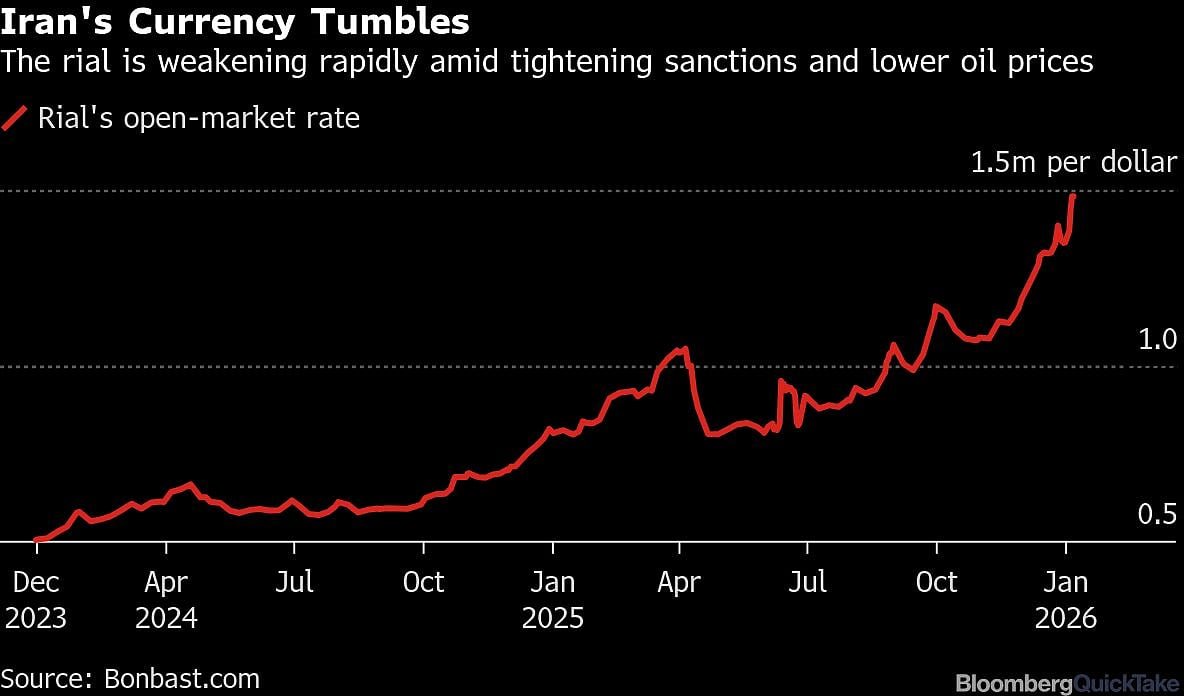
The protests have escalated into the most serious challenge to 86-year-old Khamenei and his theocratic government since a nationwide uprising in 2022. They started in Tehran’s Grand Bazaar on Dec. 28 after a slump in the value of Iran’s currency to record lows, worsening a cost-of-living crisis in the sanctions-hit economy.
The death toll since the unrest began has risen to 42, according to the US-based Human Rights News Agency, which tracks protests and the activities of political activists in Iran. UK broadcaster BBC said it had independently confirmed at least 21 of the fatalities.
The OPEC member’s situation has been worsened by corruption and by oil prices falling heavily in the past year. Benchmark Brent has risen about 4% this week to above $62 per barrel, its biggest weekly gain since October, amid the protests.
The unrest disrupted air travel in and out of the country. Non-Iranian airlines canceled all Friday flights between Tehran and Istanbul as of 11:30 a.m. local time, with additional delays and cancellations in Dubai, according to airport websites.
Monitoring group Netblocks on Thursday reported a nationwide shutdown of the internet in Iran. Various efforts by Bloomberg to reach individuals in the country by landline and mobile phone failed. One Tehran resident said phone calls weren’t working at all or were cutting in and out, and SMS messages were heavily restricted.
Iranian authorities frequently resort to such tactics during periods of unrest as they seek to prevent people sharing images of state violence against civilians.
Even so, videos posted on X and Instagram overnight showed large numbers of people gathered on several major streets in different areas of Tehran, the capital. One clip appeared to show hundreds in a central thoroughfare in the Karim Khan neighborhood chanting “death to the dictator.”
In the city of Isfahan, protesters pulled down the entrance sign of a branch of state TV — which has downplayed the protests — while flames burned in the background.
Bloomberg hasn’t been able to verify the videos.
In at least one post, the chant of “Long live the shah” can be heard. That’s a reference to the late Shah of Iran — deposed during the 1979 revolution — and his son, Reza Pahlavi, who lives in exile in the US.
Pahlavi, 65, says he wants to lead a transition to democracy in Iran and has urged Iranians to protest. On X, he called on them to “make the crowd even larger” on Friday evening.
US President Donald Trump on Thursday called Pahlavi a “nice person” but said he wasn’t sure that it would be “appropriate” to meet him. The rule of Pahlavi’s father was widely despised and its overthrow gave birth to the Islamic Republic.
“I think that we should let everybody go out there, and we’ll see who emerges,” Trump said in an interview. He reiterated warnings to Iran against killing protesters, saying “if they do that, they’re going to have to pay hell.”
Khamenei said Trump should “focus on running own country if capable” and that his hands are “stained with blood” after the US and Israeli airstrikes on Iran in June.
What Bloomberg Economics Says: “A collapse appears unlikely for now. Iranians are frightened of chaos, having seen it wreak havoc in neighboring Iraq and Syria. The government remains in control and could still crack down hard. But the risks rise the longer protests persist — and would jump sharply if war breaks out.”
. Read more on World by NDTV Profit.