
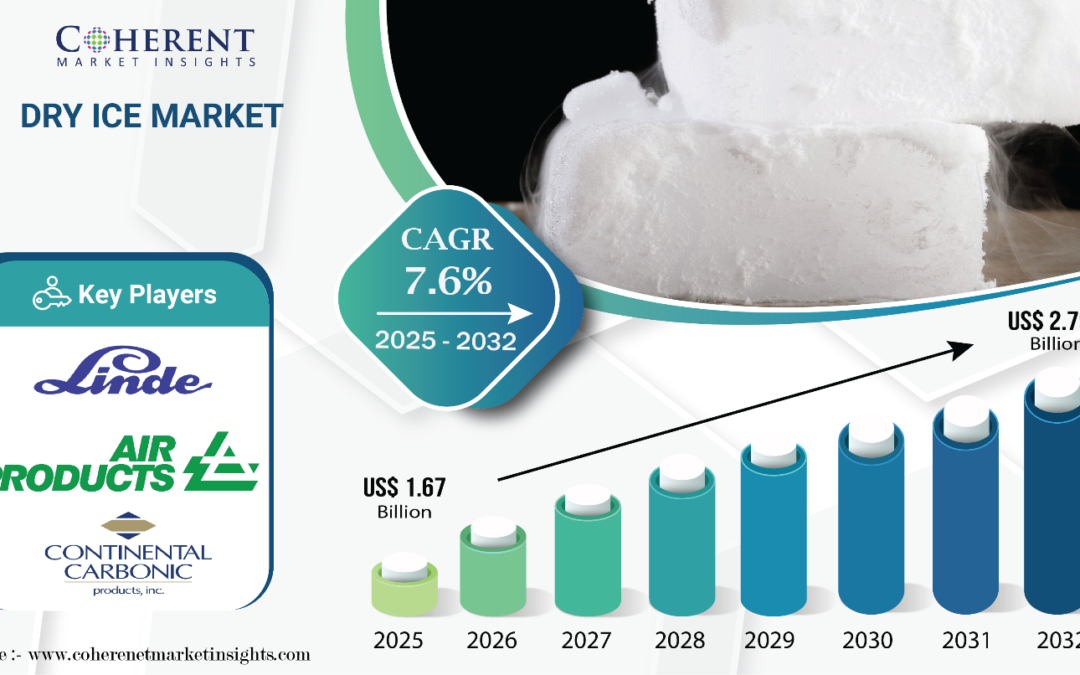
Burlingame, CA, May 22, 2025 (GLOBE NEWSWIRE) — The global dry ice market is projected to grow from an estimated value of USD 1.67 billion in 2025 to USD 2.79 billion by 2032, reflecting a compound annual growth rate (CAGR) of 7.6% from 2025 to 2032. Dry ice, which is the solid form of carbon dioxide (CO2), is a residue-free, odorless, colorless, slightly acidic, and non-flammable substance. It is created by compressing and cooling gaseous carbon dioxide (CO2) under extremely high pressures, leading to the formation of liquid CO2 in the initial stage of production.
Request Sample Report @ https://www.coherentmarketinsights.com/insight/request-sample/7684
Global Dry Ice Market Key Takeaways
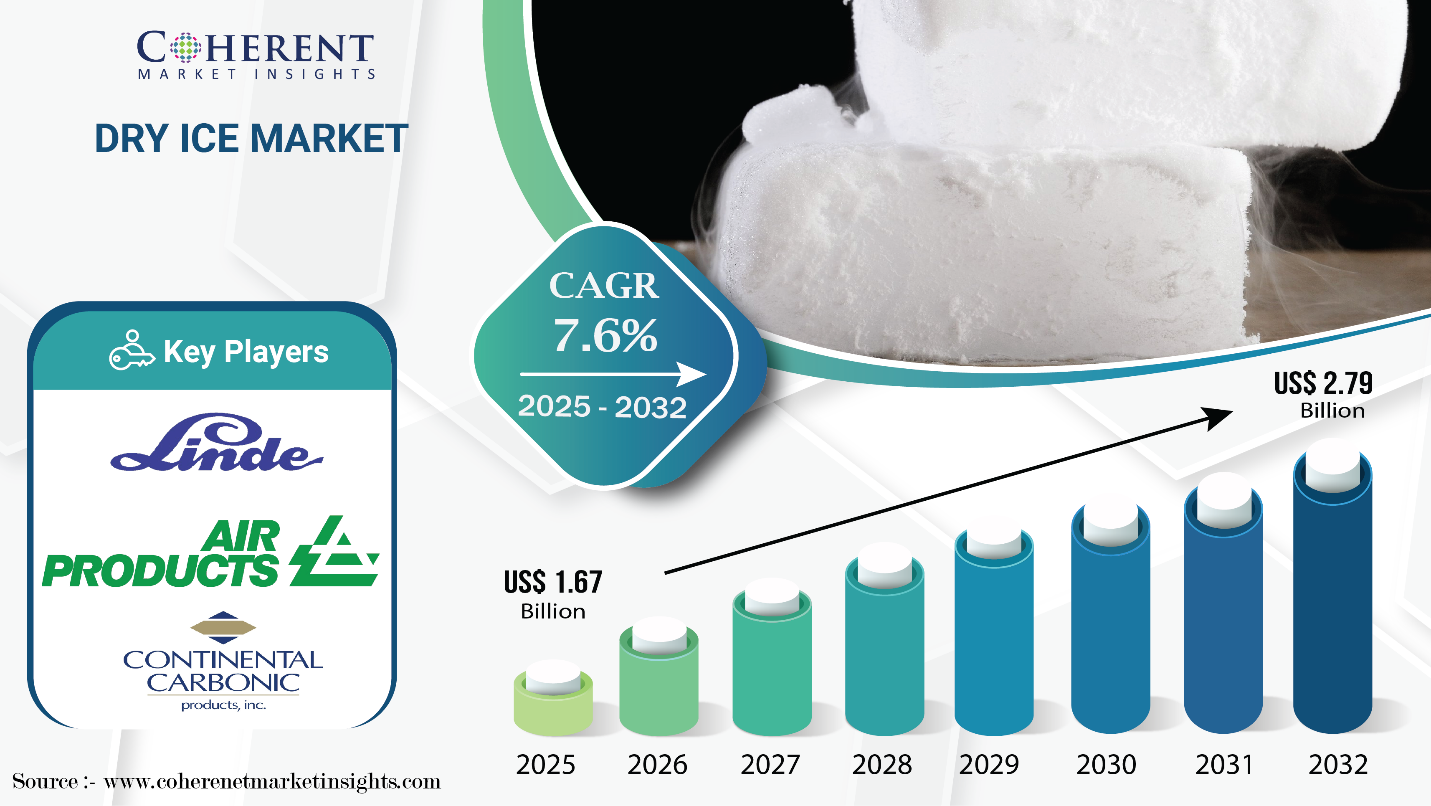
According to Coherent Market Insights (CMI), the global dry ice market size is forecast to expand at a CAGR of 7.6%, growing from USD 1.67 Bn in 2025 to USD 2.79 Bn by 2032.
Based on type, sliced segment is anticipated to account for more than two-fifths of the global dry ice market share in 2025.
By production method, the liquid CO2 method will likely hold a prominent market share of 50.3% in 2025.
Food & beverage remains the most remunerative application for dry ice manufacturers. The target segment is projected to account for nearly 2/5 share of the dry ice market in 2025.
As per Coherent Market Insights’ latest dry ice market analysis, Asia Pacific is set to retain its dominance, owing to expanding food & beverage and healthcare industries. The region will account for more than one-third of the global dry ice market revenue share in 2025.
North American dry ice market is estimated to be valued at USD 0.50 Bn in 2025.
Also Read: Food Preservatives Market Size, Share & Trends Analysis Report (2025-2032)
Expansion of Cold Chain Logistics Fueling Dry Ice Market Growth
Coherent Market Insights’ latest dry ice market research report outlines prominent factors driving industry growth. One such factor is the expanding cold chain logistics globally.
Cold chain logistics infrastructure is growing rapidly due to increasing international trade of perishable goods, including food products, pharmaceuticals, and biological samples. This, in turn, is expected to create a high demand for effective cold chain solutions like dry ice.
Dry ice, known for its ability to maintain ultra-low temperatures without leaving moisture residue, is widely used in cold chain logistics. This is due to its tendency to preserve temperature-sensitive goods like biologics and food items during storage and transportation.
Limited Shelf Life and Availability of Alternative Restraining Market Growth
The future dry ice market outlook looks bright. However, factors like limited shelf life of dry ice and availability of alternatives are expected to limit market growth to some extent in the coming years.
Dry ice sublimates directly into carbon dioxide gas without melting. As a result, it cannot be stored for long periods, particularly in non-insulated environments.
Many industries are adopting alternatives like gel packs, liquid nitrogen, and mechanical refrigeration to preserve perishable products during storage and transportation. Increasing usage of these …