
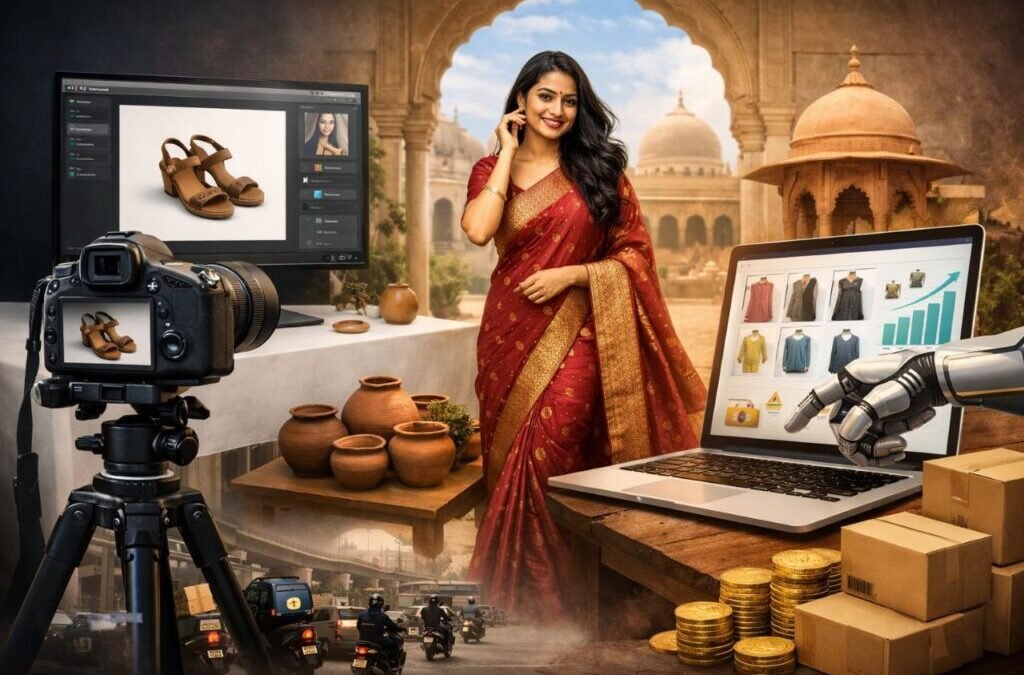
The Indian e-commerce sector is witnessing a parabolic trajectory. With the rise of D2C (Direct-to-Consumer) brands on platforms like Shopify, Amazon India, and Flipkart, the entrepreneurial barrier to entry has never been lower. However, while setting up a store is cheap, customer acquisition costs (CAC) and operational overheads remain the silent killers of profitability.
For investors analyzing the viability of new retail startups, one metric is increasingly crucial: operational efficiency. One of the most significant, yet often overlooked, costs for online retailers is the “Visual Supply Chain”—product photography and editing. This article analyzes how AI tools are slashing these costs and improving margins for Indian SMEs.
The Hidden Cost of “Going Online”
In a physical store, a customer can pick up a product. Online, the image is the product.
Traditionally, a high-quality catalog required a significant capital injection:
- Studio Rental: ₹10,000 – ₹50,000 per day.
- Photographer: ₹5,000 – ₹20,000 per day.
- Post-Production: Outsourced editing often costing ₹200-₹500 per image.
For a bootstrap startup launching a clothing line with 50 SKUs, the initial creative cost could easily exceed ₹1 Lakh. This is capital that is not being spent on inventory or marketing.
The AI Arbitrage: Zero Marginal Cost Creativity
Artificial Intelligence is disrupting this cost structure. New SaaS (Software as a Service) platforms utilizing computer vision are automating the entire post-production workflow.
1. Automated Background Removal
Indian marketplaces like Myntra and Amazon have strict guidelines (usually pure white backgrounds). Previously, this required manual clipping. Modern AI product photography tools can now process thousands of images in minutes, isolating products from cluttered backgrounds with higher precision than manual editors, specifically handling complex Indian textiles and jewelry intricacies.
2. Generative Scenery for Social Media
While marketplaces want white backgrounds, Instagram requires “vibes” and context. Instead of flying a model to Goa for a beach shoot, D2C brands are using Generative AI to synthetically place their products in lifestyle environments. A saree photographed in a Mumbai living room can be digitally transported to a palace courtyard.
- Financial Impact: This eliminates travel logistics and location fees entirely, reducing the cost of a lifestyle image from thousands of rupees to near zero.
Investment Perspective: SaaS as a Defensive Moat
From an investor’s perspective (on platforms like Trade Brains), startups that leverage these AI tools demonstrate better capital allocation.
- Speed to Market: AI tools allow brands to shoot and list a product on the same day. In fast fashion, where trends change weekly, this speed is a competitive advantage.
- Scalability: A human team cannot scale editing linear to sales volume during Diwali sales. AI software scales instantly without overtime pay.
Case Study: The Solopreneur Advantage
Consider a small home-based business selling handmade terracotta pots.
- Traditional Route: Shoot on mobile -> Photos look amateur -> Low conversion rate -> High Ad spend -> Failure.
- AI Route: Shoot on mobile -> Use AI to clean background and add soft shadows -> Photos look professional -> Higher Trust -> Better ROAS (Return on Ad Spend).
This leveling of the playing field means that small Indian brands can compete visually with global giants, fostering a more robust SME ecosystem.
Conclusion
For entrepreneurs and investors in the Indian market, AI is not just a buzzword; it is a deflationary force. It lowers the cost of production, thereby increasing gross margins. As we move through 2024, the most successful e-commerce startups will not necessarily be the ones with the biggest creative budgets, but the ones with the smartest, AI-integrated workflows.
The post Bootstrapping: Cutting Creative Overheads for Indian E-commerce Startups with AI appeared first on Trade Brains Features.