
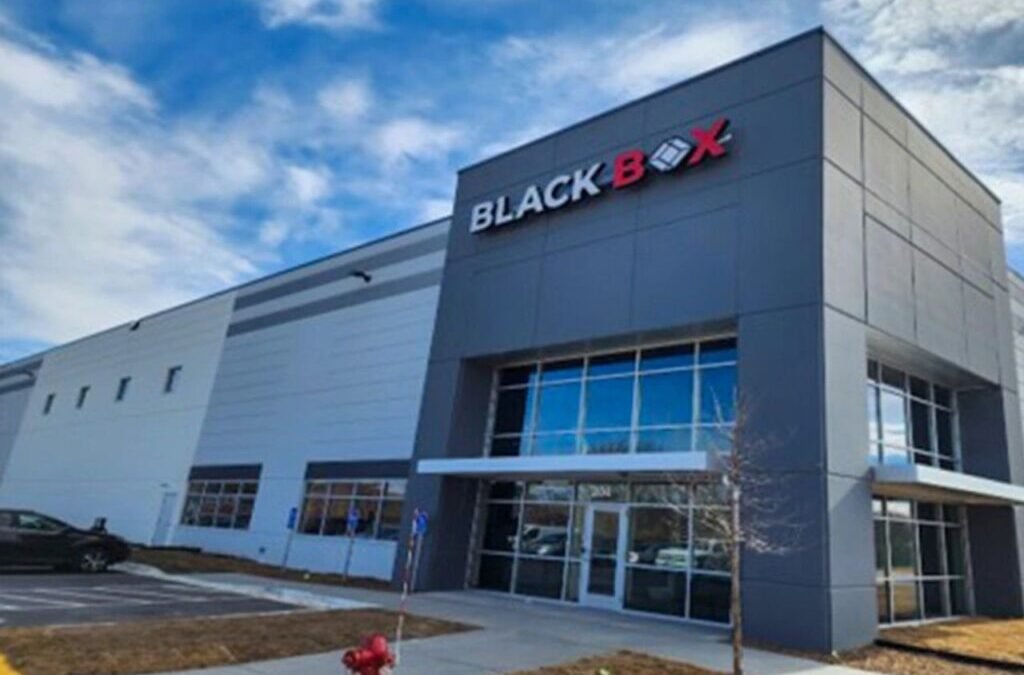
Synopsis: Black Box is a global digital infrastructure solutions provider benefiting from strong demand in data centres and connectivity. While revenue growth has been modest due to execution delays and supply constraints, profitability and margins have improved. With a strong order book, rising AI exposure and acquisitions, the company expects stronger execution and growth momentum ahead.
As global demand for data centres, cloud infrastructure and digital connectivity accelerates, Black Box has been quietly helping power mission-critical technology environments for some of the world’s largest enterprises, including names like Meta and Bloomberg. With improving profitability, a growing order book and rising exposure to the AI-driven infrastructure cycle, what does Black Box do and how does it earn?
About Black Box
Black Box is a global provider of digital infrastructure solutions, offering services such as network and system integration, managed services, and technology products to large enterprises, including many Fortune 100 companies. The company operates across key regions including the United States, Europe, India, Asia Pacific, the Middle East, and Latin America, and supports clients in industries like financial services, technology, healthcare, retail, public sector, and manufacturing.
It serves a wide range of well-known global clients such as Bank of America, Intel, Dell, Meta, TJX, Infosys, HP, IBM, Wells Fargo, Deloitte, Disney, Cognizant, TCS, HCLTech, Airtel, Vodafone, IKEA, Bloomberg, Honda, SPX, Bergstrom, Miami International Airport, and CDW, highlighting its strong enterprise relationships across sectors.
Black Box also works closely with leading technology partners including Dell, LG, Microsoft, Oracle, Genesys, Hewlett Packard Enterprise, Corning, Cisco, Assertion, Honeywell, Panduit, Symantec, and Crestron, which helps the company deliver integrated and advanced technology solutions to its customers.
What Do They Offer?
Black Box operates across a broad set of industries, positioning itself as a full-stack digital infrastructure and technology solutions provider. Its services span critical sectors such as airports, broadcast, data centres, education, financial services, government, healthcare, manufacturing, retail, transportation, utilities, power, oil and gas, modern workplaces, entertainment venues, as well as military, defence and public safety. This wide presence reflects the company’s role in supporting essential infrastructure and enterprise technology needs across multiple end markets.
From a geographic perspective, the company generates the majority of its revenue from North America, which contributes about 67 percent, followed by Europe and Asia Pacific at around 10 percent each, India at 7 percent, and smaller contributions from the Middle East and Africa and Latin America at about 3 percent each.
By industry, technology and financial services together account for nearly half of revenues, followed by consumer and public services, commercial and industrial, healthcare, and distributors. The top ten clients contribute around 46 percent of revenue with relationships typically lasting over two decades, while Global Solutions Integration remains the largest business segment contributing about 84 percent of revenue, with Technology Product Solutions at 14 percent and others making up the balance.
Solutions Portfolio
Connectivity Infrastructure
Black Box provides the core infrastructure that allows organizations to connect and manage their networks efficiently. Its fiber connectivity solutions support both single-mode and multi-mode networks, enabling everything from office setups to large hyperscale data centres to run smoothly. The company also offers IoT, security, and surveillance solutions that help businesses use data and analytics to improve operations, reduce costs, and make better decisions. In addition, it designs and manages structured cabling and passive infrastructure, helping clients build reliable digital foundations across single sites or global deployments.
Data Centre
The company delivers end-to-end data centre solutions focused on performance, scalability, and efficiency. It helps plan and design infrastructure, optimize space and cabling, and manage critical components such as racks and configurations through advanced data centre infrastructure management capabilities. Black Box also builds secure and high-performance networks using technologies like software-defined networking, firewalls, and load balancing, while offering managed services that include maintenance, troubleshooting, consulting, and interconnect solutions to ensure smooth day-to-day operations.
Enterprise Networking
Black Box supports enterprise connectivity through a wide range of networking solutions. Its local area network services help organizations build efficient communication systems that improve collaboration and productivity, while wide area network solutions enable secure and reliable connectivity across global locations. The company also provides cloud networking services that help businesses manage workloads, improve flexibility, and control costs. In addition, wireless and private LTE solutions allow organizations to enhance operations and customer experiences through reliable wireless connectivity.
Modern Workspace
To support evolving workplace needs, Black Box offers solutions that enable hybrid and digital work environments. These include unified communications and collaboration tools, desktop and edge solutions that improve performance and data management, and customer experience platforms that use analytics and advanced technologies to improve interactions. The company also delivers audio-visual integration for collaboration spaces such as meeting rooms and offices, along with AV-as-a-service models. Its IntelliPact platform brings together insights across systems, networks, and operations to give businesses a single view of performance.
Cybersecurity
Black Box provides a comprehensive set of cybersecurity services designed to protect digital infrastructure and business systems. Its managed detection and response solutions use advanced analytics and automation to identify and respond to threats across endpoints, cloud environments, and networks. The company also offers infrastructure security, identity and access management, and threat and vulnerability management services to help organizations protect data, ensure compliance, and maintain strong security across their technology environments.
Services
Black Box also provides a comprehensive suite of services that support clients across the full lifecycle of their technology infrastructure. Its offerings include consulting and design services such as hybrid workplace transformation, structured cabling design, and comprehensive AV solutions, along with project management covering on-demand plus engagements, global multisite deployments, and end-to-end planning, execution and oversight. The company delivers field services through a global workforce with on-demand support, site assessments, logistics and warehousing, and staging and configuration.
In addition, it offers support services including a 24/ 7 service desk, incident management, monitoring and request management. Its managed services portfolio spans staff augmentation, financial services, data center services, managed service desk and managed UCaaS, while refurbish and repair services include certified refurbish and repair, guaranteed performance, superior network security, system services, inventory management and e-waste solutions.
Products
Black Box also offers a broad portfolio of products designed to support connectivity, infrastructure and digital operations across enterprises. Its product offerings include audio video solutions that help deploy digital signage, enhance presentations and support modern collaboration needs, along with cabling solutions that ensure reliable connectivity from desktop environments to large data centers.
The company provides infrastructure products such as cabinets, racks, enclosures and accessories to help store, secure and protect IT equipment. In addition, it offers IoT solutions that enable remote monitoring and protection of mission critical assets, KVM solutions that allow secure remote access and simplified control of systems and workflows, and networking products that help build and scale secure, high performance networks across organizations of all sizes.
How Much Do They Earn?
Quarterly Performance
Black Box reported a sales growth of about 10.51 percent year-on-year in Q3, marking a recovery after nearly eight to ten quarters of largely muted or negative revenue growth. Revenue for Q3FY26 came in at Rs. 1,660 crore. Operating profit also improved, although the increase remained modest, with operating profit standing at Rs. 147 crore during the quarter. Net profit for the quarter was Rs. 50 crore.
Operating margins have remained relatively stable over the past nine quarters, staying within a range of around 7 percent to 9 percent. While profit after tax had shown strong year-on-year growth earlier, the trend has softened over the last three quarters. Management also noted that reported PAT for Q3FY26 was impacted by a one-time exceptional charge of about Rs. 6 crore related to changes in employee benefit provisions following the implementation of the new Labour Code. Excluding this impact, underlying profitability trends remain stable.
Yearly Performance
On a full-year basis, revenue trends have remained subdued, with sales declining from around Rs. 6,200 crore in FY23-FY24 to Rs. 5,967 crore in FY25. Trailing twelve-month revenue currently stands at about Rs. 6,175 crore. Despite muted revenue, operating profit has improved significantly, rising from roughly Rs. 250-270 crore in FY22-FY23 to Rs. 538 crore in FY25, with TTM operating profit at Rs. 537 crore.
Operating margins have expanded meaningfully from about 4 percent in FY23 to roughly 9 percent in FY25 and on a TTM basis. Net profit has also grown strongly, increasing from Rs. 73 crore in FY22 to Rs. 205 crore in FY25, with TTM net profit at Rs. 213 crore. Over the past three years, compounded profit growth stands at about 52 percent, highlighting improved profitability despite slower revenue growth.
Balance Sheet Trends
On the balance sheet, reserves have increased sharply and stood at Rs. 871 crore as of September 2025. Borrowings have also risen significantly and are currently at Rs. 1,038 crore. Receivables have seen only a modest increase and are at Rs. 674 crore, while cash and cash equivalents remain stable at Rs. 286 crore. Cash flow from operations for FY25 was negative at Rs. 88 crore.
Management Commentary and Financial Outlook
Management stated that the company will continue to focus on cost discipline, pricing strategy, and improving its product mix. Ongoing efficiency and cost optimization initiatives are expected to create further room for margin expansion as strategic priorities continue to be executed. The company expects profit growth to outpace revenue growth over time, supported by margin normalization, better revenue quality, and a higher contribution from high-value opportunities.
Management also highlighted that business momentum remains encouraging, supported by a strong and expanding order book and improving pipeline visibility. For the first nine months of FY26, the company recorded order bookings of about 626 million dollars and remains confident of achieving its full-year order booking guidance of around 1 billion dollars. This is expected to help the company enter FY27 with strong momentum.
The order backlog is now expected to reach around 800 million dollars by the end of March 2026, which is about 100 million dollars higher than the earlier estimate of 700 million dollars. This implies an expected growth of about 60 percent year-on-year compared to the earlier estimate of 40 percent. The increase reflects continued customer demand and validation of the company’s investments in go-to-market capabilities, providing strong revenue visibility going forward.
Of the incremental 100 million dollar increase in backlog, around 40 million to 45 million dollars relates to revenue that was earlier expected to be recognized in FY26 but has shifted due to temporary customer delays and supply chain constraints, which are expected to normalize and flow into FY27. The remaining 55 million to 60 million dollars is expected to come from additional order wins in the fourth quarter, supported by improving traction across key verticals and a stronger customer pipeline.
The project order book also saw strong growth, rising to about 195 million dollars in Q3FY26 from 158 million dollars in Q2FY26, reflecting an increase of 37 million dollars. This growth was driven by the company’s focus on securing large and high-value contracts, particularly in the data centre segment, which continues to be a key growth driver.
Outlook
Management highlighted that project execution timelines have been extended due to industry-wide shortages of key inputs such as optical fibers, cables, GPUs, racks, power infrastructure and even funding access, particularly in the data centre ecosystem. While demand and order inflow remain strong, these supply constraints have delayed project start and execution, pushing some revenue recognition into later periods.
As a result, the company has revised its FY26 revenue guidance to Rs. 6,325 crore to Rs. 6,375 crore from the earlier expected range of Rs. 6,750 crore to Rs. 7,000 crore, with expected EBITDA of Rs. 555 crore to Rs. 575 crore and PAT of Rs. 220 crore to Rs. 230 crore. Management noted that these challenges are temporary and once supply chains normalize, the extended backlog is expected to convert into revenues.
Despite near-term execution delays, order momentum remains strong with several large data centre wins, multiple U.S. public sector contracts, a major order from a leading Indian internet company, and a large deal from a prominent bank in Australia, reflecting strong global demand and client confidence. The company also signed a definitive agreement to acquire Brazilian IT infrastructure and cybersecurity integrator 2S Inovações Tecnológicas, which serves around 650 customers and is expected to add about Rs. 500 crore in revenue in FY27.
The acquisition, expected to close by the end of the current fiscal year, aligns with the company’s strategy to scale the business to 2 billion dollars by FY29 and is expected to generate an EBITDA run rate of around Rs. 50 crore post integration, with synergies targeted within 90 days.
Management also pointed to extremely strong demand for connectivity infrastructure, especially fiber, driven by heightened activity in AI and data centre projects, particularly in North America where most execution is currently taking place. The company supports several large global technology customers and noted that some backlog worth around 40 million dollars to 50 million dollars has shifted due to delays, but expects execution to pick up as supply conditions improve.
With a strong pipeline, expanding order book and improved ability to win large and complex projects, management remains confident of catching up on execution through FY27 and continuing to grow organically as project business gradually becomes more annuity-like over time.
Disclaimer: The views and investment tips expressed by investment experts/broking houses/rating agencies on tradebrains.in are their own, and not that of the website or its management. Investing in equities poses a risk of financial losses. Investors must therefore exercise due caution while investing or trading in stocks. Trade Brains Technologies Private Limited or the author are not liable for any losses caused as a result of the decision based on this article. Please consult your investment advisor before investing.
The post Black Box Ltd: What Does This Data Centre Leader Do And How Does It Earn? appeared first on Trade Brains.