
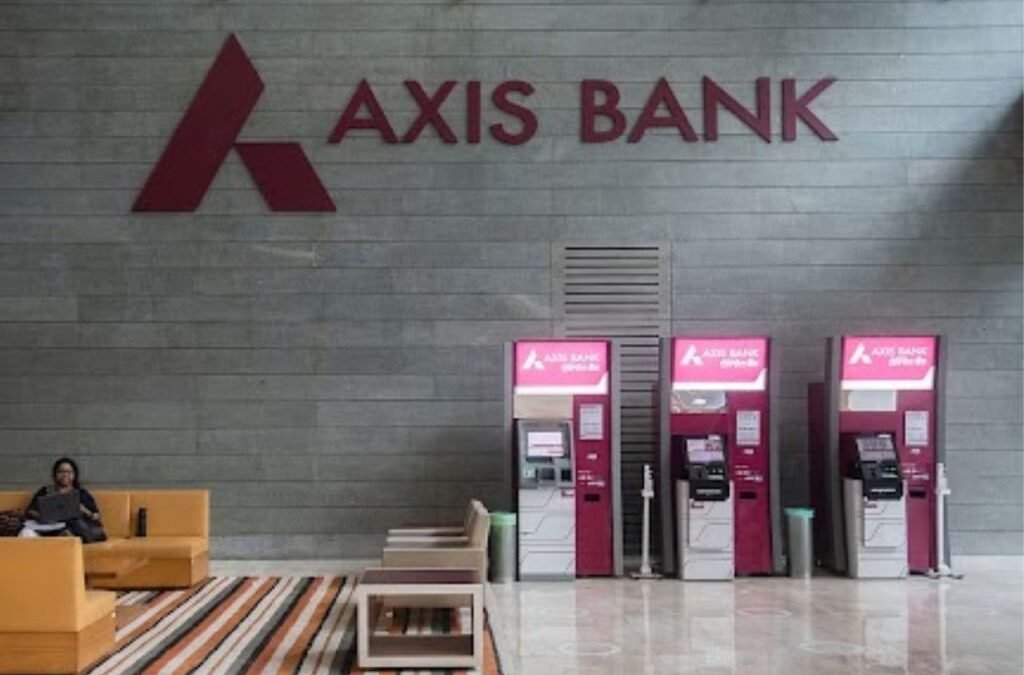
Synopsis: Against a backdrop of rising provisions and a one-time Citi tax benefit that softened the landing, Axis Bank reported a 7.3 percent decline in standalone full-year net profit to Rs. 24,457 crore for FY26; the stock fell 3.6 percent on Monday as the market absorbed the provisioning surge and a quiet net NPA uptick.
Shares of India’s third-largest private sector bank declined sharply in Monday’s session, after the lender filed its audited FY26 results on April 25, a disclosure revealing full-year earnings under pressure despite a material tax gain tied to the Citibank India acquisition.
With a market capitalisation of Rs. 4,09,335.96 crore, the shares of Axis Bank Limited were trading at Rs. 1,316.7 per share, down 3.6 percent from its previous closing price of Rs. 1,365.9. It is trading at a P/E of 16.11.
On a standalone basis, full-year net profit for FY26 came in at Rs. 24,456.66 crore, a decline of 7.27 percent from Rs. 26,373.48 crore in FY25. The dip is sharper than it first appears: the bank received a one-time tax credit of Rs. 2,193.20 crore in Q4 after income tax authorities concluded their assessment and allowed depreciation on intangibles recognised from the Citibank India consumer business acquisition in FY23. Without that relief, the full-year profit figure would have been materially weaker.
Running in the opposite direction, the bank voluntarily created an additional standard asset provision of Rs. 2,001 crore in Q4 FY26 described in the filing as a prudent balance sheet measure, not a response to any specific credit stress.
This came on top of a Rs. 1,231 crore one-time provision taken in Q2 following an RBI advisory on declassified PSL loans, taking the combined one-time provisioning charge for the year past Rs. 3,232 crore. The two offsetting items leave investors with the task of deciding which is the better indicator of underlying earnings capacity.
Total standalone income for FY26 rose 3.54 percent year-on-year to Rs. 1,53,163.08 crore, which means the earnings contraction was entirely driven by cost and provisioning pressure rather than a revenue slowdown. That distinction matters for how the bank exits FY27 if provisioning normalises.
Gross NPA ratio improved to 1.23 percent as of March 31, 2026, from 1.28 percent a year ago, a directionally positive move. Net NPA, however, ticked up to 0.37 percent from 0.33 percent in the comparable period, a movement the filing does not elaborate on but that sits somewhat uneasily alongside the decision to build extra provision cover in Q4. Capital Adequacy Ratio under Basel III stood at 16.42 percent, down from 17.07 percent a year prior, still well above regulatory minimums.
The board recommended a dividend of Rs. 1 per share for FY26, subject to shareholder approval. Consolidated advances grew to Rs. 12,82,392 crore from Rs. 10,81,229 crore a year ago, an 18.6 percent expansion that signals the bank has continued pushing loan book growth even as profitability came under pressure.
Business Overview
Axis Bank Limited, incorporated in December 1993, is the third-largest private sector bank in India by branch network, listed on both BSE and NSE.
Disclaimer: The views and investment tips expressed by investment experts/broking houses/rating agencies on tradebrains.in are their own, and not that of the website or its management. Investing in equities poses a risk of financial losses. Investors must therefore exercise due caution while investing or trading in stocks. Trade Brains Technologies Private Limited or the author are not liable for any losses caused as a result of the decision based on this article. Please consult your investment advisor before investing.
The post Axis Bank Shares Slump 4% After FY26 Profit Dips to ₹24,457 Cr Amid High Provisions appeared first on Trade Brains.