
AMD (NASDAQ:AMD) announced it beat Wall Street’s expectations by $600 million. Yet shares plunged 9% premarket, erasing more than $30 billion in market value.
The selloff was not panic, it was recognition.
The smartest money on Wall Street just figured out that AMD’s entire 2026 growth story depends on six things going perfectly right, and most of them are already going wrong. The company reported great numbers for the quarter that just ended. But the future quarters? Those are built on switches that don’t ship until next year, memory chips already sold to competitors, and a biggest customer burning through $50 billion annually while scrambling for emergency funding.
For retail investors betting on AMD’s AI surge, the key question isn’t “did they beat last quarter?”. It’s “can they execute flawlessly over the next nine months?”. At 40 times forward earnings (40x P/E, the priciest among major chip stocks), AMD’s valuation assumes perfect execution on chip launches, infrastructure rollouts, customer deals, and cost control. Any stumble sends the stock tumbling from 40 times earnings toward 25 to 30 times. That’s potential downside of 25% to 40%.
Let’s see what retail investors need to understand about the risks Wall Street is now pricing into AMD’s stock.
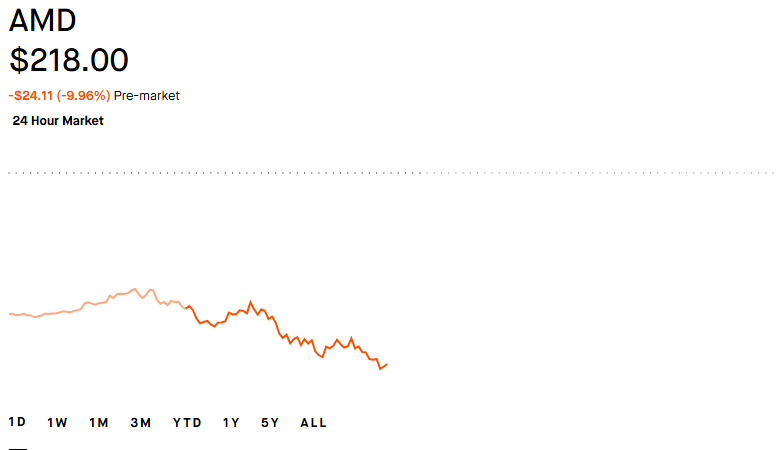
AMD shares plunged 9% premarket, erasing more than $30 billion in market value.
The $390 Million Trick That Fooled No One
AMD beat revenue estimates by $600 million in the fourth quarter. Wall Street dug into the details and found something uncomfortable: $390 million came from a one-time windfall in China sales. The Chinese government approved export licenses stuck in bureaucratic limbo. AMD shipped chips it didn’t expect to ship. Then the window closed.
For the first quarter of 2026, AMD expects just $100 million in China revenue (a 75% drop). If China stays at that level all year, AMD brings in $400 million instead of the $800 million to $1.2 billion analysts expected. That’s a $400 million to $800 million shortfall, or $2 billion to $3 billion in lost market value.
Susquehanna analyst Chris Rolland told CNBC: “When you account for that China revenue, the beat was far less substantial than we would’ve thought.”
The Spending Problem Management Can’t Fix
For four straight quarters, AMD promised to control operating expenses. For four straight quarters, spending came in roughly $200 million higher than guidance.
Bernstein’s Stacy Rasgon put it bluntly: “The opex ramp is starting to become a bit tiresome… execution against spending guidance has been lackluster.”
This really matters because AMD’s data center operating margins fell from 29% to 25% (a 400 basis point drop). The company promises margins will hit 35% by late 2026. The current trajectory says otherwise.
AMD is asking investors to pay 40 times earnings based on the promise that profits will grow faster than revenue. That only happens if costs stay controlled while sales scale. Four quarters of broken promises …