
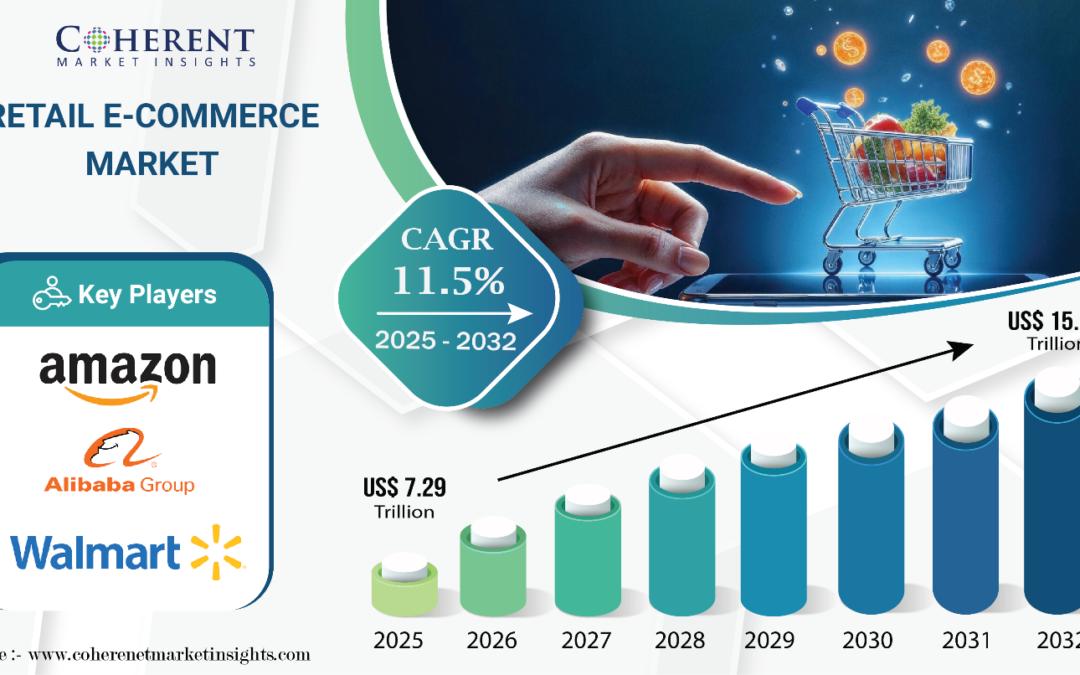
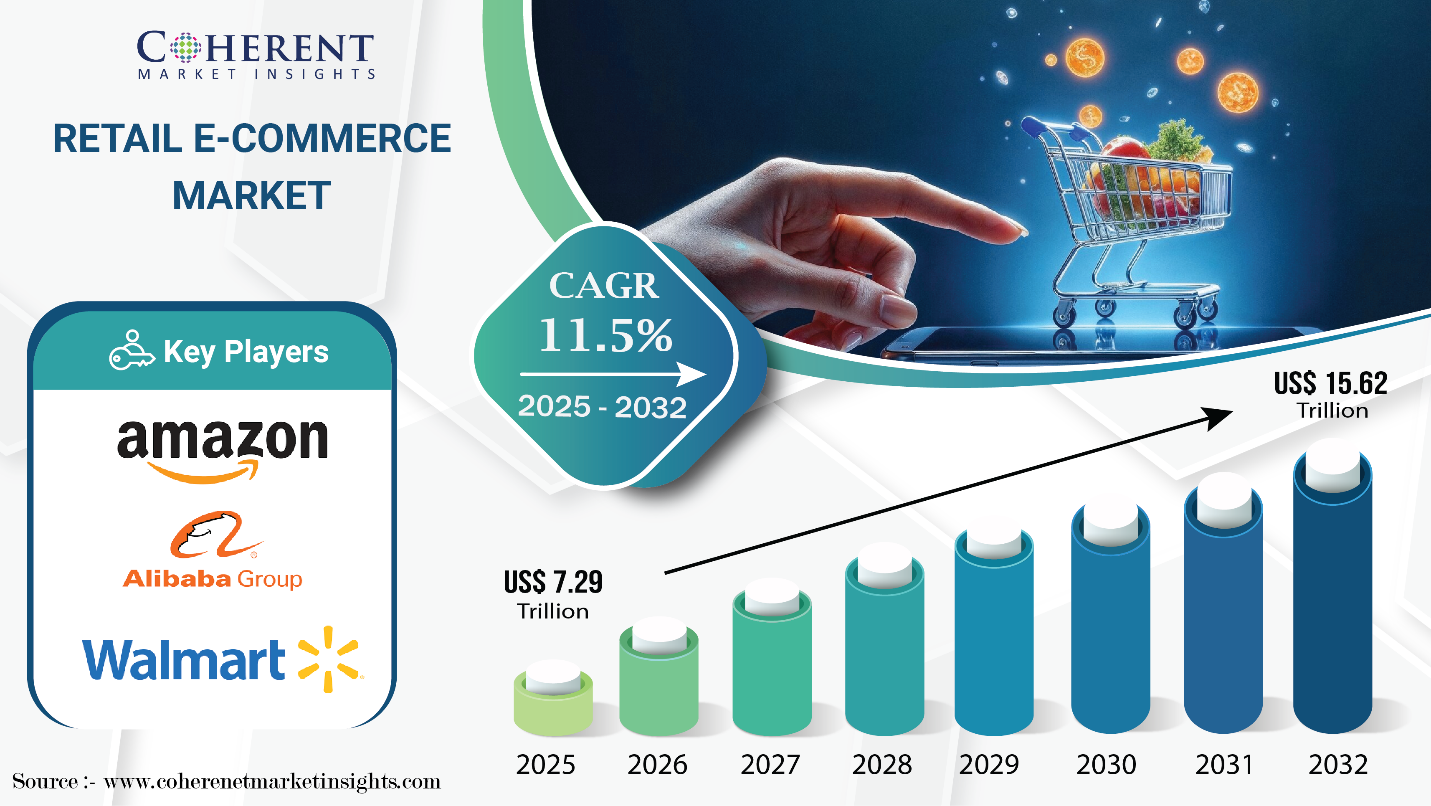
Burlingame, CA, June 12, 2025 (GLOBE NEWSWIRE) — The Global Retail E-Commerce Market is estimated to be valued at USD 7.29 trillion in 2025 and is expected to reach USD 15.62 trillion by 2032, exhibiting a compound annual growth rate (CAGR) of 11.5% from 2025 to 2032. According to a new report by Coherent Market Insights. The retail e-commerce market has experienced strong growth in recent years, driven by the global rise in internet and smartphone usage. Increasingly, consumers are opting for online shopping over traditional in-store experiences. This shift was further accelerated by the COVID-19 pandemic, as lockdowns and movement restrictions made online retail the preferred and often only option for many shoppers.
Request Sample Pages: https://www.coherentmarketinsights.com/insight/request-sample/7769
Global Retail E-Commerce Market Key Takeaways
According to Coherent Market Insights (CMI), the global retail e-commerce market size is anticipated to expand at a CAGR of 11.5% during the forecast period, reaching USD 7.29 Tn in 2025 to USD 15.62 Tn by 2032.
Global demand for retail e-commerce is projected to increase at a strong pace throughout the assessment period as consumer convenience takes center stage.
Based on product category, fashion (apparel and accessories) segment is expected to account for nearly one-third of the global retail e-commerce market share in 2025.
By sales channel, online marketplaces segment is projected to hold a market share of over 3/5 in 2025.
As per Coherent Market Insights’ latest retail e-commerce market analysis, Asia Pacific is set to dominate the global industry, holding a market share of more than 2/5 in 2025.
The Middle East retail e-commerce market is expected to experience fastest growth during the projection period.
Rising Consumer Demand for Convenience Fueling Market Growth
Coherent Market Insights’ latest retail e-commerce market report highlights major factors spurring the industry’s growth. One such prominent growth driver is the growing consumer preference for convenient shopping experiences.
Modern consumers often favor the ease of online shopping over visiting brick-and-mortar stores. This trend is expected to propel demand for retail e-commerce throughout the assessment period.
Convenience remains a top reason consumers choose online shopping instead of going to physical stores. E-commerce platforms offer unparalleled convenience to customers by allowing them to shop 24/7 from the comfort of their homes.
Growing popularity of this on-the-go-shopping culture is expected to play a key role in boosting the e-commerce market growth. Similarly, broad accessibility to a wide range of products through online shopping platforms further encourages the adoption of retail e-commerce.
Data Privacy Concerns and Logistics Challenges Limiting Growth
The prospective retail e-commerce market outlook looks optimistic. However, concerns around data security and logistics challenges are expected to somewhat hinder market growth to some extent during the assessment period.
Many consumers are reluctant to shop online due to fear of identity theft, fraud, and rising incidence of data breaches. These concerns may lead to a reduced retail e-commerce market demand in the coming years. Increasing …