
The Bank of England (BOE) cut interest rates on Thursday as the United Kingdom struggles with economic uncertainty abroad and political disruption at home.
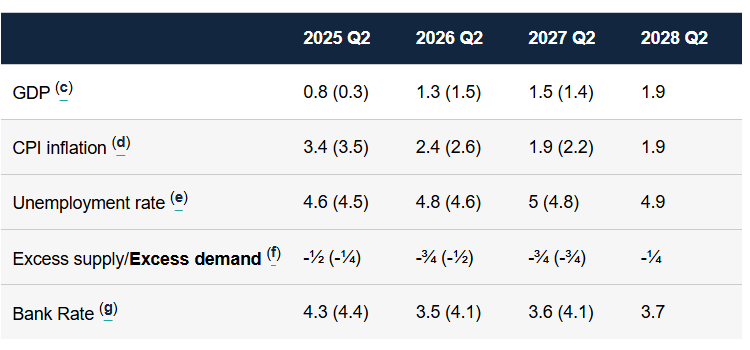
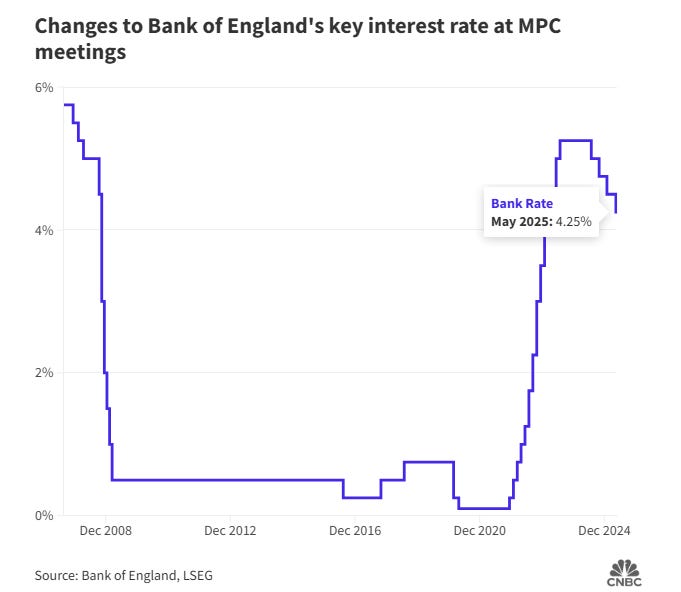
The central bank reduced its key interest rate from 4.5% to 4.25% at its latest monetary policy meeting, citing substantial progress on disinflation. Underlying UK GDP has slowed since the middle of 2024, and the labour market “has continued to loosen,” it said.
“Uncertainty surrounding global trade policies has intensified since the imposition of tariffs by the US,” the central bank said. “Prospects for global growth have weakened as a result of this uncertainty and new tariff announcements, although the negative impacts on UK growth and inflation are likely to be smaller.”
The BOE Monetary Policy Committee “judges that the risks around GDP growth in this forecast are somewhat to the downside.” The Chancellor of the Exchequer, Rachel Reeves, said in late March that the economy would grow just 1% this year, down from the previous forecast of 2%.
US President Donald Trump’s tariffs have raised uncertainty about the British economy, which suffers from lackluster growth. On Thursday, Trump unveiled the broad outlines of a trade agreement with the UK.
It will be the first with a country whose imports were subject to new tariffs imposed by Trump in early April. Trump did not announce further details.
Bank of England Rate Cut In Line with Consensus
Five of the BOE’s nine policymakers voted for the cut, with two members wanting a larger 50 basis-point reduction, and two wanting to keep rates on hold. The cut was in line with the consensus, with inflation slowing to 2.6% in the twelve months to March, from 2.8% the previous month.
Investors, though, had looked for signals the BOE would pivot from its “previous script” that future cuts would be “gradual and …