
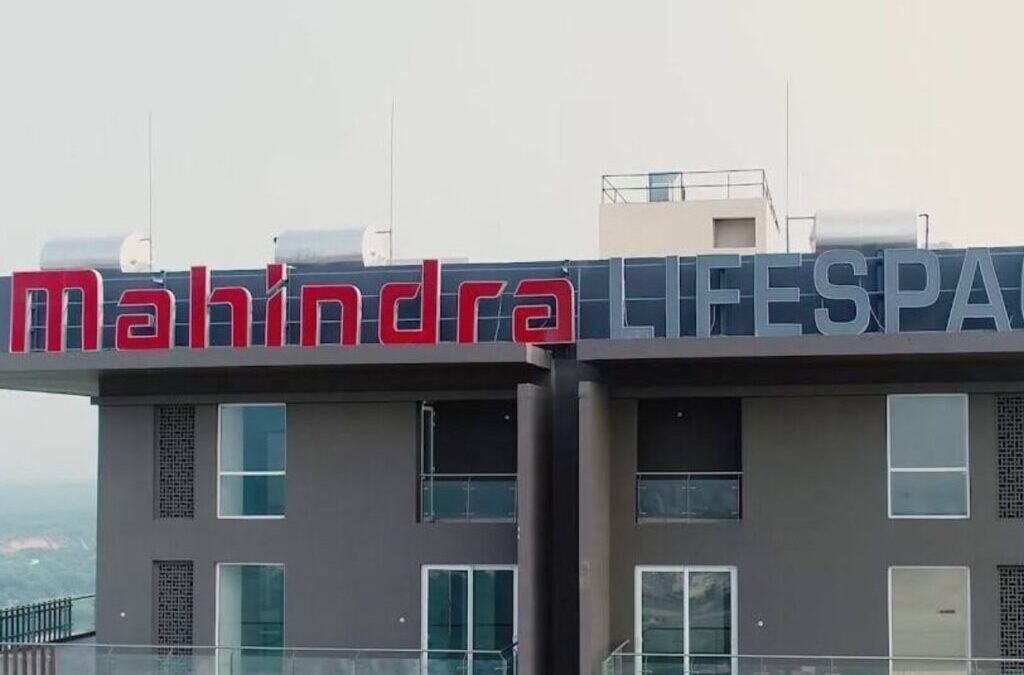
Synopsis: Mahindra Lifespace Developers is showing signs of a stronger growth phase, driven by fresh project additions, rising pre-sales, industrial park momentum, and a cash-surplus balance sheet. The bigger story may not be quarterly numbers, but whether the company is entering a new multi-year expansion cycle.
India’s real estate sector has seen a sharp shift over the last few years. Demand recovery, premiumisation, organised developer gains, and industrial infrastructure expansion have changed the outlook for listed property players. Against this backdrop, one of India’s prominent real estate developers with exposure across both residential housing and industrial & integrated business parks is beginning to stand out as a player balancing two growth engines urban home sales and industrial land monetisation.
With a market capitalisation of ₹7,270 crores, the shares of Mahindra Lifespaces Developers are trading at ₹341 a piece in today’s market session, The stock has delivered 7.55 percent in the last month
Why This Theme Matters
Real estate companies are often valued not only on current profits, but on future project pipeline, balance sheet strength, and ability to launch and monetise inventory. For Mahindra Lifespaces, rising GDV additions and stronger operational momentum could indicate that a fresh growth cycle is underway.
₹18,060 Cr GDV Addition Signals Future Revenue Visibility
The company added nearly ₹18,060 crore worth of GDV in FY26, broadly sustaining the previous year’s pace. This matters because GDV additions represent future monetisable projects. For developers, a growing pipeline can support pre-sales, collections, and earnings over multiple years. The standout piece was the ₹7,500 crore Thane unlocking, which could become an important value driver going forward.
Residential Momentum Appears Strong
Residential pre-sales rose to ₹3,405 crore, up 21% YoY, while Q4 pre-sales surged 55% YoY to ₹1,633 crore. This indicates healthy customer demand and better execution across launches such as Blossom, Marina64, and NewHaven. If momentum sustains, the residential segment could remain the key growth engine.
Industrial Parks Business Adds Diversification
Unlike many pure-play developers, Mahindra Lifespaces also has exposure to industrial clusters and industrial parks. IC&IC revenues rose to ₹713 crore, up 44% YoY, while leasing activity remained healthy in Jaipur and Chennai. This gives the company exposure to India’s manufacturing, warehousing, and industrial capex themes alongside housing demand.
Balance Sheet Strength Could Be a Key Advantage
Real estate growth often depends on capital availability. Here, Mahindra Lifespaces stands out with a cash-surplus balance sheet. A net debt-to-equity ratio of 0.18 suggests lower leverage pressure and better ability to pursue land acquisition, project launches, or partnerships during opportunities.
Future Outlook
Management has outlined an aggressive FY27 growth roadmap with over ₹10,000 crore of business development targets, led by Mumbai (60%) and supported by Pune and Bengaluru (20% each), alongside residential sales guidance of ₹4,500–5,000 crore, signalling continued expansion across key urban markets.
Key Risks to Watch
Slower residential demand due to interest rate pressure, Delays in approvals or project launches, Real estate price correction in key markets, Execution risk in large new developments, Industrial leasing slowdown if capex weakens
Market Takeaway
Mahindra Lifespaces may be transitioning from a steady real estate name into a more scalable dual-engine growth story, combining residential launches with industrial land monetisation.
If execution remains strong and new project additions continue, the bigger opportunity may lie not in one year’s earnings, but in a deeper multi-year rerating tied to pipeline growth and balance sheet strength.
Company Finanacials
Year-on-Year analysis: Revenue from operations has increased from ₹372 crores in FY25 to ₹1,178 crores in FY26, up 217%. with reported operating losses being ₹122 crores and net profit of ₹298 crores for the same period.
Quarter on Quarter analysis: Revenue from operations has increased from ₹459 crores in Q3’FY25 to ₹670 crores in Q4’FY26, with reported operating losses being ₹44 crores and net profit of ₹90 crores for the same period.
A key financial nuance is that the company’s core operations have remained under pressure, with operating losses reported for the last five years. However, reported profitability has been supported by strong non-operating income streams such as share of profits from joint ventures, subsidiaries, asset monetisation gains, and other treasury-related income.
Disclaimer: The views and investment tips expressed by investment experts/broking houses/rating agencies on tradebrains.in are their own, and not that of the website or its management. Investing in equities poses a risk of financial losses. Investors must therefore exercise due caution while investing or trading in stocks. Trade Brains Technologies Private Limited or the author are not liable for any losses caused as a result of the decision based on this article. Please consult your investment advisor before investing.
The post ₹18,000 Cr GDV: Is Mahindra Lifespaces Back in Dual-Engine Growth Mode? appeared first on Trade Brains.