
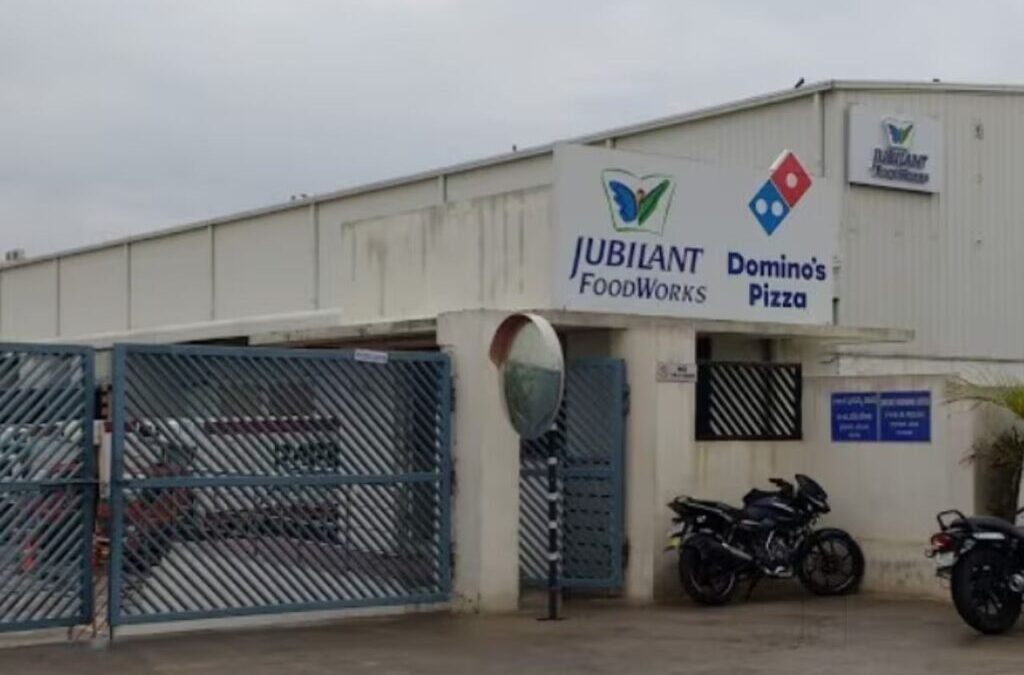
Synopsis: A major consumer stock has corrected sharply, raising questions about whether the weakness is in the share price alone or in the business itself. The latest quarter, management commentary, margin trends, expansion plans, and future strategy together offer a clearer picture of what is really happening beneath the surface.
A quick service restaurant stock that once looked like one of the strongest consumer growth stories in the market is now under pressure, with Jubilant FoodWorks falling nearly 40 percent from its highs and raising fresh doubts over whether Domino’s growth engine is starting to lose momentum. Even though the company is still reporting revenue growth, margin improvement, and store expansion, investors are clearly asking a tougher question now: Is The Domino’s Power House Actually Becoming Weak?
How Did Jubilant FoodWorks Perform In The Latest Quarter?
Jubilant FoodWorks reported a strong performance in Q3FY26, with consolidated revenue rising 13.3 percent year-on-year to Rs. 24.4 billion, supported by growth across all business segments. EBITDA increased 20 percent, with margins improving by around 110 basis points to 20.5 percent, while profit after tax from continuing operations (before exceptional items) surged 94 percent, with margin expansion of 167 basis points.
The India business remained the key driver, with revenue growing 11.8 percent year-on-year to Rs. 18 billion. Domino’s India delivered 5 percent like-for-like growth on a strong base and recorded its eighth consecutive quarter of positive LFL growth, supported by healthy order growth of 10 percent. The company also undertook selective price increases and benefited from new product launches like sourdough pizzas and cheese lava pull-aparts, which saw strong customer response and supported margins. Gross margin in India improved to 74.9 percent, expanding both sequentially and over the past six months despite inflation in key inputs.
Store expansion remained aggressive, with 114 net additions during the quarter across markets, including 75 new Domino’s stores in India. The company now operates close to 3,600 stores globally, with around 2,530 in India. Popeyes continued to scale well, delivering strong double-digit LFL growth for the second straight quarter and expanding to 73 stores, indicating rising traction.
On the international side, Turkey continued to perform strongly with double-digit growth, steady profitability, and enough cash generation to service acquisition-related debt. Sri Lanka and Bangladesh also reported strong top line growth along with improving profitability. Overall, the quarter reflected strong execution, margin expansion, continued store growth, and improving performance across geographies, with the company continuing to invest with discipline toward building a 5,000-plus store network over time.
Is Domino’s Power House Actually Becoming Weak?
Management does not believe the Domino’s business is weakening. The clear internal target is to build a business that can deliver 5 to 7 percent like-for-like growth, around 15 percent standalone revenue growth, and move closer to 15 percent pre-Ind AS margins. According to management, there are no visible headwinds that would stop the business from sustaining this kind of growth.
They also pushed back on the concern that growth could slow because the base has become too high. Their argument is that the business has already absorbed that pressure. The company is now completing two years since the free delivery strategy began, so the earlier high-growth period is no longer a fresh base effect. Management pointed out that standalone growth in FY25 was 14.3 percent, while growth in the first nine months of the current year has risen to 15.1 percent. In simple terms, they are saying the company is already growing faster on a bigger base, which does not support the idea that the business is weakening.
Management also said the company has started tracking market share gains through AC Nielsen and believes it is gaining share not only in pizza, but also across adjacent categories such as bowls, chicken, and burgers. That is an important point because it suggests the company is not just defending its core business, but also expanding its presence across a wider part of the food market.
Margins Are Improving for a Reason
One of the more important messages from management was that margin improvement is not accidental or temporary. They explained that in earlier periods, the company was investing for growth through free delivery and value-led products, which helped acquire customers but were margin dilutive. Now the company is trying to improve profitability using a different set of levers.
These levers include calibrated price increases, tighter cost control, better product mix, and more efficient execution. Management said recent launches such as Sourdough Pizza and Cheese Lava Pull Apart are helping gross margins, unlike some older growth investments that had diluted profitability. They also said the company has tightened cost structures to get more out of EBITDA.
Another point they made was that several cost lines are growing slower than revenue. Personnel and manufacturing expenses are rising, but not in line with business growth, which means operating leverage is starting to come through. Management believes there is still more room for optimization from here. They also said the current gross margin improvement trend should continue as long as the company keeps growing and keeps improving its mix.
On possible cost pressure from labour code changes, management indicated that the impact could be around 10 to 15 basis points at the outer limit, and they do not see it as material. They also said they have been disciplined on headcount and have started using technology and AI to improve efficiency in corporate overheads, which is also helping margins.
The Company Is Focused on Its Own Channels, Not Platform Fees
On competition from food delivery platforms, management made it clear that its strategy is not built around copying aggregators. They acknowledged that platforms such as Swiggy and Zomato have lowered minimum order values and increased fees in some cases, and Jubilant has matched certain pricing moves where necessary to protect market share. But beyond that, management said its priority is to grow its own assets and make them the best place for customers to order from.
They do not see platform fees as central to their business model, although they said that lever is available if ever required. Their broader view is that extra fees can become a barrier to acquiring customers, especially when the company is trying to build a much larger and more penetrated network over time.
Management also said that delivery remains the fastest growing channel globally and that the company wants to continue riding that trend. At the same time, they admitted that dine-in and takeaway still needed work. They said they are going back to the drawing board on that part of the business, reviewing what is working and what is not. They admitted that performance there could have been better last quarter, but also made it clear they are not giving up on that channel.
They also explained how customer behavior has changed over time. Before COVID, dine-in was the main channel for acquiring new customers, who would then shift to delivery later. Now the company’s own app is becoming the main acquisition channel, which management sees as positive because it gives them direct customer data and more control over the user experience.
Alongside this, the company is experimenting with monetizing its post-order page. Management said it has been positively surprised by advertiser interest and the quality of brands engaging with this space. They believe the business can eventually monetize this channel to around 1 percent of revenues and potentially build it into a three-digit crore opportunity over time. But they also stressed that they do not want to interfere with the ordering journey itself, which is why they are only monetizing the post-order stage and not the pre-order experience.
The Real Competition Is Much Bigger Than Pizza
Management’s view is that the company’s opportunity is much larger than just competing with other QSR chains. They pointed out that India is a 60 billion dollar food services market and said the real competition is everyday food such as bhatura chana, dosa, idli, biryani, and snacks. The point they are making is that pizza frequency is still low, and the real growth opportunity is to win one more eating occasion from the much larger universe of everyday food consumption.
This is why the company is trying to play across price points. At the premium end, it is launching products such as Sourdough Pizza to appeal to higher-value customers. At the entry end, it is offering lower-priced pizzas that can compete with more routine food purchases. Management said the broader goal is to make pizza relevant on more occasions, including light hunger moments where a customer might otherwise choose something like a samosa.
That is an important part of the future plan because it shows the company is not thinking only about same-store growth in a mature category. It is trying to increase category penetration itself.
Expansion Plans Show Confidence, Not Caution
If management thought the business was weakening, the future plan would likely become more defensive. Instead, the company is planning for a much larger network. Management repeatedly referred to building a 5,000-store business rather than just a 3,000-store business. They also said the company wants to open 1,000 stores over the next three years.
This expansion plan is not being presented as a blind land grab. In fact, management specifically said they do not want to open stores aggressively only to shut them later. Their view is that growth has to be sustainable. They said site selection is now fully AI enabled, that the company already has a list of 1,000 store opportunities, and that new stores are opening with lower capex and strong first-year throughput.
They also said the company is entering schools, colleges, airports, and railway stations at a pace not seen before. In management’s view, this creates fresh white-space growth beyond just relying on mature urban markets. They described India as a very large, multi-decadal opportunity and said they continue to find large pockets of demand.
Management also noted that mature store ADS was the highest ever in the last quarter, which they see as another sign of brand strength rather than weakness.
There Could Be Upside if Industry Demand Improves
Another important point was that management believes the current 5 to 7 percent LFL range could move higher if the broader industry environment improves. They did not make a formal forecast beyond that range, but they agreed that if the QSR space moves from negative same-store sales growth to positive growth, Domino’s could benefit further.
Management said the company has historically outperformed the rest of the pack by around 3 to 4 percent because of execution, self-help initiatives, and brand strength. So their argument is that the company is already doing well in a weak market, and if the market itself improves, the business could perform even better.
Capex Will Stay High, but the Mix Is Changing
Management said overall capex over the last few years has been in the range of Rs. 700 crore to Rs. 850 crore. Supply chain capex has peaked, but they do not expect a major drop in total capex because investment is now shifting toward store expansion and technology.
This is tied directly to the growth plan. The company wants to keep investing behind a larger store base and stronger technology systems because management believes those investments can support both growth and efficiency. They also expect these newer investments to deliver better paybacks and better return on capital than some earlier supply chain investments. So while capex is not likely to fall sharply, management believes the quality of capital deployment is improving.
Popeyes Is Emerging as a Serious Growth Driver
A major part of the future outlook is Popeyes. Management said Popeyes should add around 1 to 1.5 percent to growth in the near term, and they sounded increasingly confident about scaling the brand further. They said Popeyes has delivered positive double-digit same-store sales growth for three quarters in a row, with the latest quarter being the strongest yet.
The company said it is optimizing Popeyes around two key things: industry-level average daily sales and industry-level or better gross margins. If those metrics hold, management believes the model can scale meaningfully. They said that if Domino’s can add 75 to 80 stores a quarter, there is no reason Popeyes cannot eventually add 15 to 20 stores a quarter as well, especially through high-street locations.
At the same time, management was realistic about margins. They said that even at scale, fried chicken businesses typically have lower margins than Domino’s, so Popeyes could remain a drag in mix terms versus the core pizza business. But the immediate focus is to get closer to restaurant-level profitability, build EBITDA profitability, and then begin generating cash.
The long-term ambition shared by management is large. They said they can see Popeyes becoming a 250-store, Rs. 1,000 crore business in the medium term, with strong profitability. They also said the brand is getting close to one-tenth of that journey already. That shows Popeyes is no longer being discussed as a side experiment. It is being shaped as a meaningful future growth engine.
Management also made it clear they do not believe a common multi-brand app is the right strategy for Popeyes and Domino’s. Their view is that customers need a much larger brand selection in one app for that model to work, and that the two brands serve different occasions. Instead, they want Popeyes to build its own app and its own customer experience.
International Business Is Reducing Risk, Not Adding Pressure
The commentary on Turkey was another important point for judging business strength. Management said the debt related to the acquisition sits in a Netherlands entity, but the key takeaway is that Turkey itself is now funding the interest burden fully through its own cash flows. This has been the case for the last three quarters. As a result, there is no remittance of funds or cash from the India business to service that interest cost.
Management also indicated that, when principal repayment comes up, Turkey’s own cash flows could help fund part of that as well. That reduces the risk that international operations become a drain on the domestic business.
Final View: The Business Does Not Look Weak, but Some Areas Still Need Work
Based on management commentary, the broader picture does not suggest that Domino’s is becoming weak. Management is guiding for steady LFL growth, stable topline growth, and improving margins. They believe the high base issue is already behind them, claim to be gaining market share, and continue to invest in expansion, technology, and customer acquisition.
At the same time, everything is not perfect. Dine-in and takeaway still need work. Popeyes is growing well but is not yet at full profitability. Capex will remain elevated. And some margin gains are still dependent on continued execution and mix improvement. But these are being framed as areas the company is actively working on, not signs of a broken model.
So the message from management is fairly clear. They do not see the business as weakening. They see it as a business that has already invested for growth, is now beginning to show operating leverage, and is still preparing for a much bigger scale in the years ahead.
Disclaimer: The views and investment tips expressed by investment experts/broking houses/rating agencies on tradebrains.in are their own, and not that of the website or its management. Investing in equities poses a risk of financial losses. Investors must therefore exercise due caution while investing or trading in stocks. Trade Brains Technologies Private Limited or the author are not liable for any losses caused as a result of the decision based on this article. Please consult your investment advisor before investing.
The post Jubilant FoodWorks Stock Down 40%; Is The Domino’s Power House Actually Becoming Weak? appeared first on Trade Brains.