
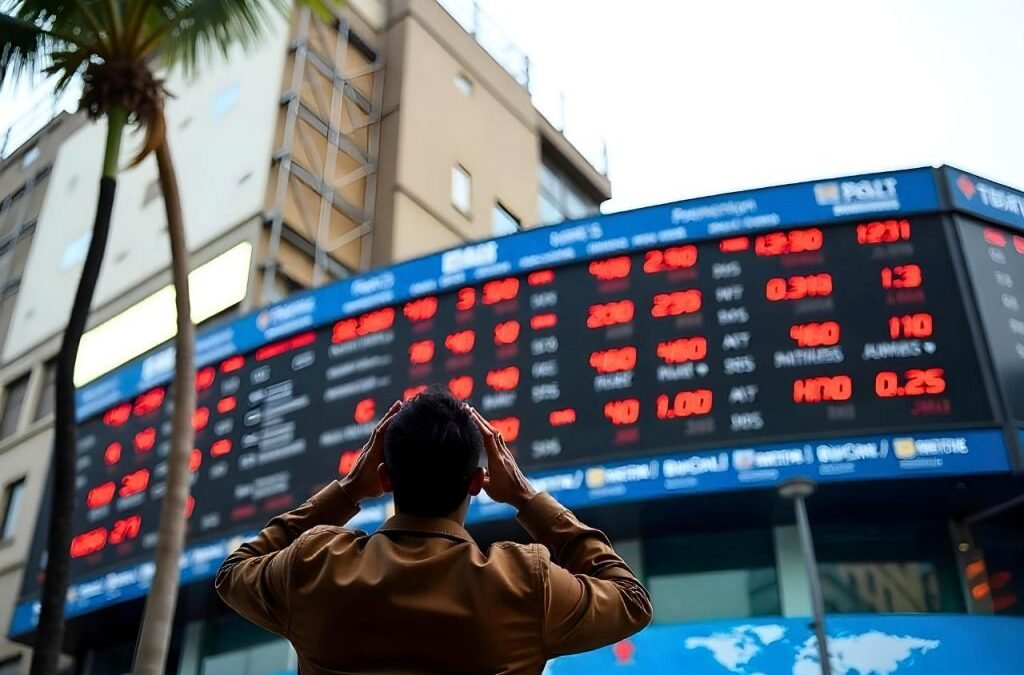
Synopsis :- Indian markets tumbled as Nifty fell 533 points to 24,645 and Sensex dropped 2,744 points. Brent crude surged 5.86% to $77.14, while the rupee weakened to 91.38 amid global geopolitical tensions.
Indian stock markets are witnessing a decline in today’s session, reflecting cautious investor sentiment and heightened volatility across key indices. Weakness is visible across multiple sectors, with broader market participation also under pressure. Traders appear to be adopting a wait-and-watch approach, leading to subdued momentum and increased fluctuations during the trading day.
Opening on Dalal Street
At the opening on Dalal Street, markets witnessed sharp selling pressure. The Nifty 50, which had closed at 25,178.65 in the previous session, opened lower at 24,659.25 and slipped further to an intraday low of 24,645.10, marking a decline of 533.55 points from its previous close. Similarly, the Sensex, after ending at 81,287.19 in the last session, opened at 78,543.7, registering a decline of 2,744.02 points, reflecting broad-based weakness in early trade.
Geopolitical Shock Triggers Global Selloff
Indian equity markets witnessed a sharp selloff on Monday after a major escalation in the Middle East conflict involving the US, Israel, and Iran. Reports of the killing of Iran’s Supreme Leader Ayatollah Ali Khamenei in joint US-Israel strikes heightened fears of prolonged geopolitical instability.
The escalation triggered a global selloff. S&P 500 futures fell 0.6%, Dow Jones declined 521 points (1.05%), the S&P 500 dropped 29.98 points (0.6%), and the Nasdaq fell 210 points (0.92%). In Asia, Japan’s Topix slipped 1.5%, Hang Seng dropped 1.8%, Australia’s ASX 200 fell 0.5%, while Shanghai Composite bucked the trend, rising 0.3%. Euro Stoxx 50 futures were down 1.4%.
Crude Oil Spike
Crude oil prices spiked sharply amid fears of supply disruption through the Strait of Hormuz, which handles nearly 20% of global seaborne oil trade and 20% of liquefied natural gas flows. Brent crude jumped 5.86% to $77.14 per barrel after briefly crossing $82.
Some analysts believe Brent may remain capped near $80, while others see risks if tensions persist. Rising crude is a major negative for India, which imports the bulk of its oil requirement, raising concerns about inflation and fiscal pressure.
Rupee Under Pressure
The US dollar strengthened sharply, with the Indian rupee weakening, currently at 91.38 per dollar mark. Safe-haven assets surged, with gold rising 1.34% to $5,349.36 per ounce. Analysts suggest that if COMEX gold sustains above $5,300, domestic prices could rise toward ₹1,68,000–₹1,70,000 per 10 grams. Silver, which closed above $93 per ounce, may test $95, and a breakout could push it toward $100 per ounce, translating to nearly ₹3,00,000 per kg in India.
Key Technical Levels
Technically, Nifty has breached its 200-day moving average and closed below the crucial 25,300 support level, forming its fourth consecutive red candle. Immediate support lies at 25,000–25,050, followed by 24,800 and 24,600. A decisive breakdown below 25,000 could accelerate selling pressure.
Bank Nifty faces key support at 60,800–60,700, with deeper support near 60,200–60,000 (50-day EMA zone). Resistance is placed at 61,400–61,500, and a breakout above 61,500 could push the index toward 62,000–62,500. Near-term range for Bank Nifty is seen between 60,000 and 61,750.
Sectoral Impact: Oil, Defence and Rate Sensitives in Focus
Rising crude is expected to pressure oil marketing companies, aviation, paint, tyre, and chemical stocks due to higher input costs. In contrast, upstream producers like Oil and Natural Gas Corporation and Oil India Limited may benefit from better realizations. Defence stocks such as Hindustan Aeronautics Limited and Bharat Electronics Limited are also expected to remain in focus amid heightened military tensions.
What Lies Ahead?
The medium-term direction of Indian markets will largely depend on the duration and intensity of the Middle East conflict. If tensions escalate further or disrupt oil supplies significantly, volatility may persist. However, any signs of diplomatic resolution or stabilization in crude prices could provide relief. Until clarity emerges, analysts advise a cautious approach, focusing on fundamentally strong large-cap stocks and avoiding aggressive positioning in highly volatile sectors.
Disclaimer: The views and investment tips expressed by investment experts/broking houses/rating agencies on tradebrains.in are their own, and not that of the website or its management. Investing in equities poses a risk of financial losses. Investors must therefore exercise due caution while investing or trading in stocks. Trade Brains Technologies Private Limited or the author are not liable for any losses caused as a result of the decision based on this article. Please consult your investment advisor before investing.
The post Why Is the Stock Market Down Today? What Lies Ahead? appeared first on Trade Brains.