
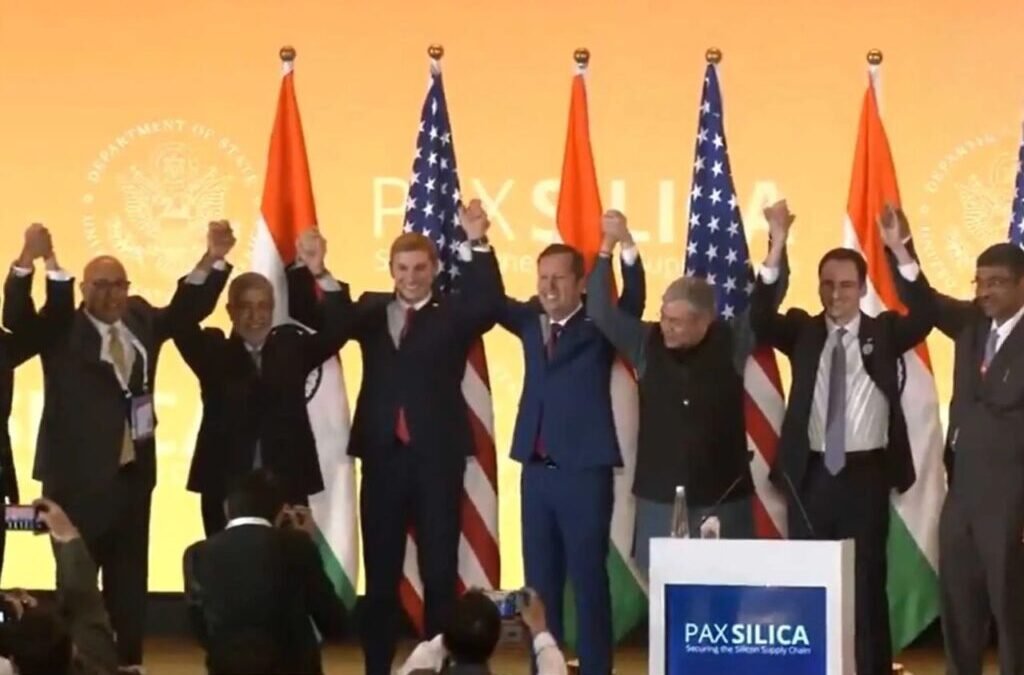
Synopsis: India joined the US-led Pax Silica initiative at the AI Impact Summit 2026, signaling deeper strategic cooperation in artificial intelligence and semiconductors while strengthening resilient, trusted global technology supply chains.
The India AI Impact Summit 2026 held in New Delhi from February 16–20 at Bharat Mandapam was a major global AI event bringing together over 20 heads of state, 60+ ministers and 500+ leaders from government and tech to discuss AI governance, inclusive growth, sovereign infrastructure and ethical AI.
Key announcements included huge private investments in AI data centres, global commitments for responsible AI, and India’s push to become a Global South AI hub with indigenous models, multilingual frameworks and expanded compute capacity, highlighting strategic partnerships and future-ready innovation.
News
India formally joined the US-led Pax Silica initiative by signing the Pax Silica Declaration on the sidelines of the India AI Impact Summit 2026. The move marks a significant step in expanding cooperation between the two countries in artificial intelligence, semiconductors, and critical supply chains. The declaration underlines the importance of resilient supply chains for economic security and positions artificial intelligence as a transformative force for long-term global prosperity.
Pax Silica is described as the US Department of State’s flagship framework aimed at building a trusted network of partners across the technology and industrial ecosystem. India’s formal entry into this coalition signals deeper integration into a structured international framework focused on securing the entire technology value chain.
Strategic Alignment Between India and the United States
At the summit, US Ambassador to India Sergio Gor described India’s participation as a pivotal moment in the evolving global technology order. He linked India’s entry into Pax Silica with broader cooperation across trade, defence, and technology, emphasizing the “limitless potential” between the two nations. The move reflects a shared intent to move beyond transactional ties toward long-term strategic collaboration.
The signing follows an interim trade agreement concluded earlier this month between India and the United States. According to officials, the agreement resolved long-standing friction points and laid the foundation for deeper economic integration. The deal was framed not merely as an arrangement on tariffs or trade flows, but as a commitment by two democracies to “build together” rather than simply transact.
A Full-Stack Technology Coalition
Pax Silica has been described as a coalition spanning the entire silicon stack; from the extraction of critical minerals to semiconductor fabrication and the deployment of frontier AI in data centers. The initiative seeks to secure the full technology ecosystem rather than focusing on a single segment of the supply chain.
The framework aims to reduce reliance on adversarial systems and replace coercive dependencies with what officials called a “positive-sum alliance of trusted industrial bases.” It is positioned as a grouping of nations that believe technology should empower free people and free markets, aligning economic security with democratic values.
Global Participation and Expanding Engagement
The Pax Silica Declaration includes signatories such as Australia, Greece, Israel, Japan, Qatar, South Korea, Singapore, the UAE, and the UK. In addition, non-signatory participants include Canada, the Netherlands, the European Union, the OECD, and Taiwan, reflecting broad international engagement across advanced technology ecosystems.
The agreement also coincides with high-level US engagement in India. US Under Secretary of State for Economic Affairs Jacob Helberg is visiting India from February 20–21 as part of the American delegation led by White House Office of Science and Technology Policy Director Michael Kratsios. The visit includes bilateral meetings and discussions focused on expanding cooperation in emerging technologies and advancing the next phase of the US AI Exports Program.
What Does This Means for AI and Semiconductor Supply Chains?
India’s entry into Pax Silica strengthens efforts to build resilient and diversified supply chains in artificial intelligence and semiconductor manufacturing. By participating in a coalition that integrates mineral extraction, chip fabrication, and AI deployment, India becomes part of a coordinated framework aimed at reducing excessive concentration risks in critical sectors.
The development also follows India’s participation in the Critical Minerals Ministerial in Washington, where External Affairs Minister S. Jaishankar called for structured international cooperation to “de-risk” supply chains. Together, these developments signal a clear policy direction: securing critical technology ecosystems through collaboration with trusted global partners.
Disclaimer: The views and investment tips expressed by investment experts/broking houses/rating agencies on tradebrains.in are their own, and not that of the website or its management. Investing in equities poses a risk of financial losses. Investors must therefore exercise due caution while investing or trading in stocks. Trade Brains Technologies Private Limited or the author are not liable for any losses caused as a result of the decision based on this article. Please consult your investment advisor before investing.
The post India Joins US-Led Pax Silica: What Does It Mean for AI and Semiconductor Supply Chains? appeared first on Trade Brains.