
Synopsis: Lenskart is called a tech company because it uses advanced data and artificial intelligence to run its stores and plan expansion. It tracks customer behaviour inside stores, improves operations, and selects new locations using predictive data models, making decisions based on insights rather than traditional guesswork.
Lenskart is an eyewear company that is built around technology. It manages everything itself from designing glasses to making them, building the brand and selling directly to customers. The company operates in several countries and sells prescription glasses, sunglasses, contact lenses and other eyewear products. Its shopping experience uses technology such as AI-based virtual try-on tools that let customers see how glasses look before purchasing.
But these visible features are only the surface. Most people notice only the stores and marketing, not the deeper systems working in the background. So what is this hidden technology that actually powers Lenskart? Let us look at two key tech strengths that truly set it apart.
TangoEye
In October 2023, Lenskart acquired Tangoeye for an undisclosed amount. However, according to Pitchbook, the deal was valued at around 1.71 million USD. Lenskart was not new to the company, it had been an early investor and had already started using Tangoeye’s technology as early as 2020-21. So, what exactly is Tangoeye?
When you walk into a store in a mall, you may notice a security guard writing something in a register or clicking a small counter. This is how stores have traditionally counted customer footfall. However, this manual method depends entirely on the guard’s attention and effort, which makes the data unreliable. Mistakes, missed entries, delays or simple carelessness can affect accuracy, and there is no proper way to check if the numbers are correct.
The issue becomes worse in multi-floor stores, where a guard on each level may count the same person again, leading to duplicate entries. As a result, stores end up with only a broad and often inaccurate headcount for the day, without any real insight into the customer.
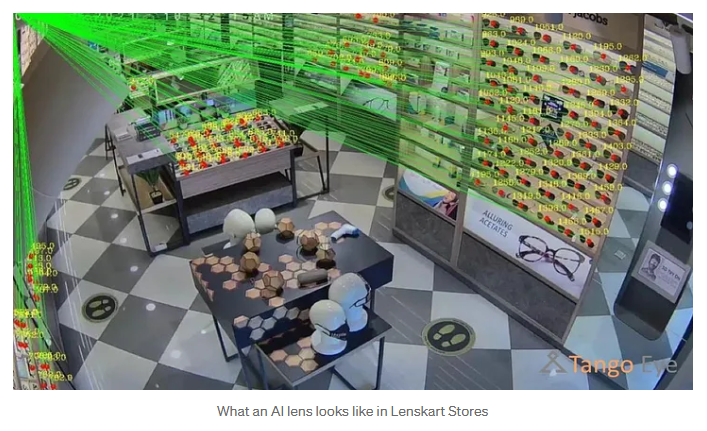
Tangoeye solves this problem using computer vision technology. It provides end-to-end video analytics solutions that use AI and machine learning to convert camera footage into useful business insights. This helps improve store efficiency, increase sales and strengthen security, all with very little manual work and almost no room for human error. One key advantage is that it does not require new hardware or software. The system simply connects to the existing DVR or NVR setup in the store and analyses video feeds from the cameras.
How Does It Help Lenskart?
TangoEye helps Lenskart move quickly from collecting data to making decisions. The technology gives the company a better understanding of its customers, their in-store experience, how they interact with staff, and how they engage with products and the brand.
Its role goes beyond just counting how many people enter a store. It also provides deeper insights into store operations, overall customer demographics, footfall patterns, customer experience and engagement levels. The system captures customer footfall with more than 95 percent accuracy, making the data far more reliable than manual counting. It can also break down the numbers into groups, individual shoppers and window shoppers.
For example, if a store has a high number of window shoppers, managers can adjust how employees interact with customers to increase engagement and turn browsing into actual purchases. The technology also tracks store opening and closing hours, helping measure how long stores operate each day. This is important because store operating hours directly affect revenue.
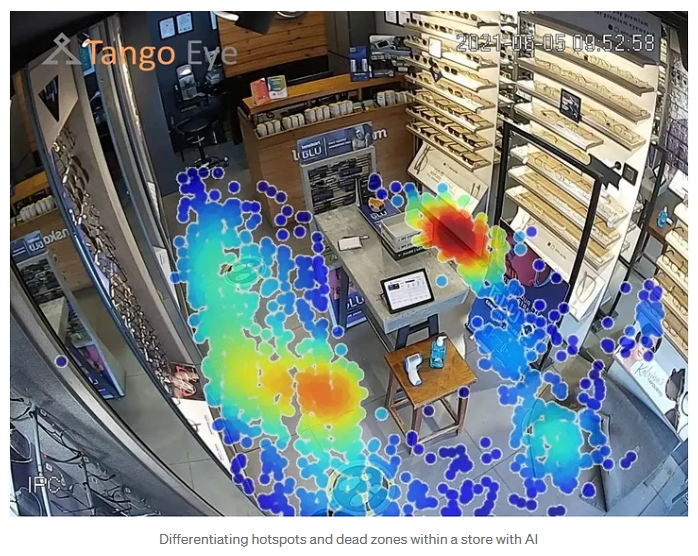
It also makes it easier to monitor product availability. The system can detect issues such as incorrect product placement or low and empty shelves and send alerts to the relevant teams. In the future, it is also expected to help with loss prevention by identifying suspicious activities and alerting teams about theft or intrusion. Another key insight comes from measuring how much time customers spend inside the store. The system identifies busy areas and less-visited zones within the store. This helps Lenskart understand how customers interact with the brand and creates opportunities for better engagement.
The data can also highlight stores that are receiving low customer traffic. Based on this, the company can run targeted marketing campaigns for those specific locations to increase footfall and potentially improve store revenue.
GeoIQ
For many years, retail companies have depended on branch teams and ground staff to find suitable locations for new stores. These teams usually study factors such as local demographics, population size, nearby competition and their performance, infrastructure, surrounding businesses and foot traffic. However, even after reviewing these details, the final decision often depends on personal judgment. There is usually no strong data to properly validate whether the selected location is truly the best choice.
This traditional approach has several weaknesses. Decisions can be influenced by personal experience or preferences, which may override facts. Ground teams may not always fully understand the product positioning or target audience. Most importantly, there is no real-world data to confirm whether a chosen site will perform well or to predict the revenue and profit potential of a new store. Because of this, businesses may miss better opportunities, and there is no clear way to measure whether a rejected location could have performed better.
With the availability of large volumes of data today, relying only on manual judgment is no longer enough. This is where GeoIQ comes in. Lenskart uses GeoIQ’s no-code machine learning model to bring intelligence into its expansion strategy. GeoIQ analyses location-based patterns in data and identifies similar behavioural trends across different regions.
It uses real-world information collected from more than 600 trusted data sources to generate hyperlocal insights across over 2,000 relevant attributes. This machine learning model helps Lenskart make more informed and data-backed decisions while selecting new store locations as part of its expansion plans.
How Does It Help Lenskart?
To use GeoIQ’s model, Lenskart provides detailed data from its existing stores, including store size, whether the outlet is company-owned or franchise-owned, opening and closing dates, staff strength, number of ophthalmologists and monthly revenue. This data is automatically cleaned and adjusted to account for newly opened stores that have not yet stabilized, differences in control between franchise and company-run outlets, and seasonal sales variations. Once processed, the data is fed into a machine learning system.
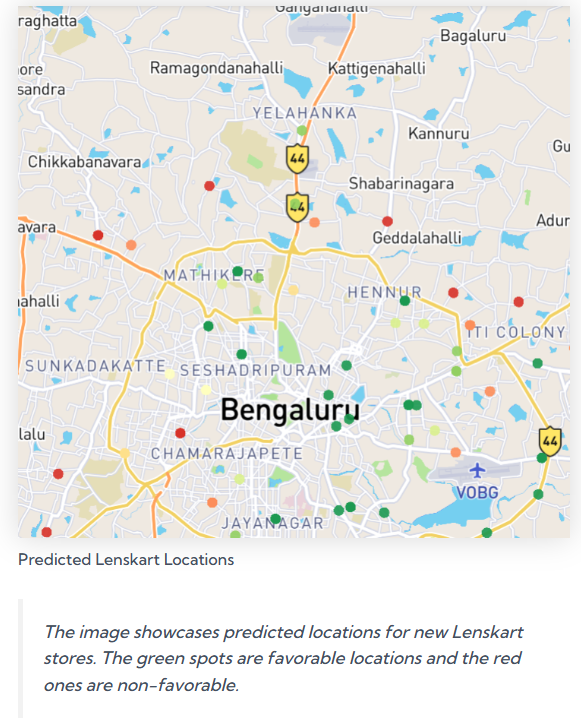
A regression model then analyses store addresses and monthly revenue, creating catchment areas ranging from 200 metres to 5 kilometres around each location. It studies more than 2,000 attributes to identify patterns linked to high-performing and low-performing stores. Using these insights, the system assigns a score to new locations and predicts expected monthly revenue by combining location attributes with Lenskart’s inputs such as rental cost and store size. It also estimates potential footfall, which directly influences sales.
The model is trained on existing store data and tested on separate datasets across different cities, not just Tier 1 or metro markets, to reduce bias and improve accuracy. This allows Lenskart to forecast how much revenue a new store could generate in the coming months. By choosing locations more carefully, the company can maximize revenue at the store level, reduce missed opportunities, and limit the risk of new stores affecting sales of nearby outlets. In the end, every potential site is given a score, where a higher score signals stronger expected performance.
At first glance, Lenskart may look like just another eyewear retailer with strong branding and attractive stores. But behind those stores is a layer of technology that quietly drives its decisions. From using computer vision to understand customer behaviour inside stores to using machine learning to choose the right locations for expansion, the company relies heavily on data rather than guesswork.
TangoEye helps Lenskart improve store performance, customer engagement and operational efficiency. GeoIQ helps it decide where to open its next store with higher confidence and lower risk. Together, these systems show that Lenskart is not just selling glasses, it is using technology to improve how it operates, expands and grows. This is why Lenskart is called a tech company. The technology may not always be visible to customers, but it plays a central role in how the business runs and scales.
Disclaimer: The views and investment tips expressed by investment experts/broking houses/rating agencies on tradebrains.in are their own, and not that of the website or its management. Investing in equities poses a risk of financial losses. Investors must therefore exercise due caution while investing or trading in stocks. Trade Brains Technologies Private Limited or the author are not liable for any losses caused as a result of the decision based on this article. Please consult your investment advisor before investing.
The post ₹80,900 Cr Valuation: Why is Lenskart considered a tech company despite being a retail brand? appeared first on Trade Brains.