
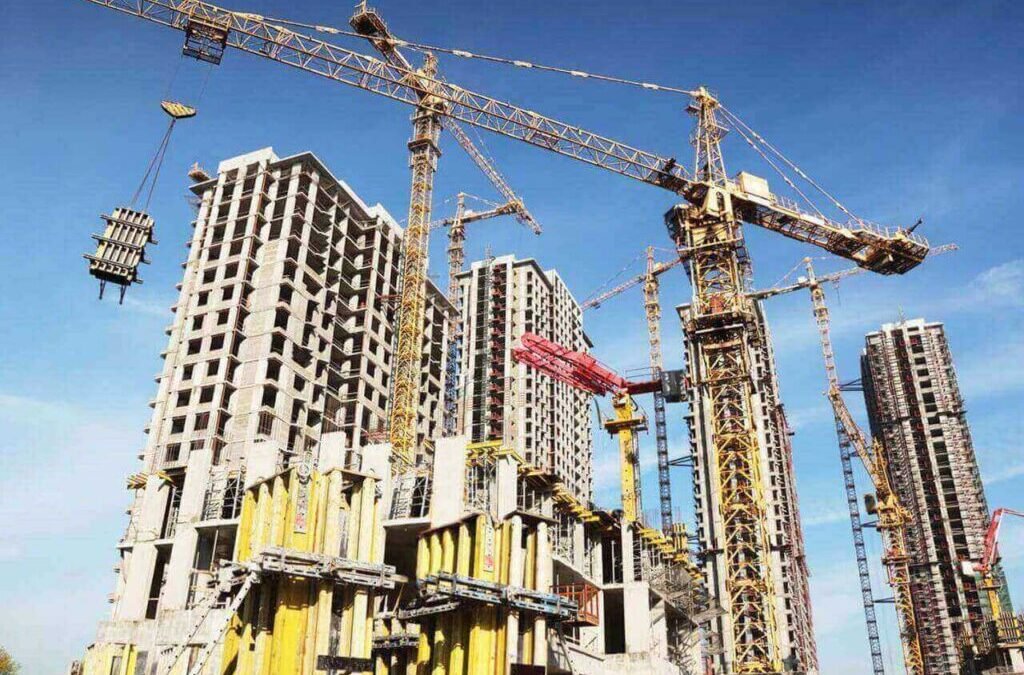
The Nifty Realty index has taken a hit, dropping by 12% over this year. This downturn reflects broader sector challenges, with heavyweight stocks like Godrej Properties plunging almost 29%, Brigade Enterprises dropping over 26%, and Oberoi Realty sliding 16.6% over the last year.
Probable reasons for the underperformance
Slow execution of projects, which leads to a gap between launches and delivery: The sector faces a creeping slowdown in project execution. Construction activity has slumped to an 8-year low, broadening the gap between new project announcements and actual physical completions. Developers continue to announce new projects, but fewer are under construction. This gap signals labour shortages, approval delays, and funding issues, which increase the risks of project delays, weaker cash flows, and margin pressures. The trend cuts across tier-1 and tier-2 cities alike, underscoring a pan-India execution crunch that dampens overall performance.
Some moderation in foreign investments: Institutional investments in the Indian real estate sector reached USD 4.3 billion during the first nine months of 2025, reflecting a 9% decline compared to the previous year. This dip signals some caution among investors amid ongoing global uncertainties, trade tensions, and external volatilities. Nevertheless, the nine-month investment volume remains above the five-year average inflow of around USD 4 billion for the same period. This resilience highlights sustained investor confidence in the strong fundamentals of the Indian economy and real estate market, underpinned by robust domestic growth, urbanization, and infrastructure developments.
Rise in construction costs: To compound woes, construction costs have rocketed nearly 40% in just five years, fueled by inflation, global supply chain disruptions, and spiking prices for both materials and labour. This relentless surge has put homebuyers, especially those looking for affordable housing, under severe pressure as developers have little choice but to pass on these costs, triggering annual price jumps of 9-12%. The squeeze is so intense that affordable housing now makes up only 12% of all new launches in the first half of 2025, an astonishing plunge from its 40% share in 2019, leaving many budget-conscious buyers increasingly locked out of the market.
Analytical view on key players in the industry
DLF Ltd
Established in 1946, DLF is the largest real estate developer in India with a legacy of over 78 years. It operates across residential, commercial, and retail segments with a presence in 15 states and 24 cities, known for developing more than 158 real estate projects and a diversified portfolio spanning over 340 million sq ft of developed area.
For Q2FY26, new sales bookings surged significantly to Rs 4,332 crore from Rs 692 crore in Q2FY25, while H1FY26 bookings jumped 122.1% year-on-year to Rs 15,757 crore. However, H1FY26 revenue grew by 34.09% YoY to Rs 5,243 crore, despite a 17% decline in Q2FY26 revenue YoY. Profit after tax (PAT) for H1FY26 fell by 4.72% to Rs 1,937 crore, with Q2FY26 PAT down 16% YoY. This decline was notably impacted by a one-time Rs 600 crore settlement on the Tulsiwadi project. The company launched a large project spanning 5.7 million sq. ft in H1FY26 with a sales potential of Rs 13,685 crore. Collections for Q2FY26 rose 12.74% YoY to Rs 2,672 crore.
The company also has a 49 million sq. ft portfolio of annuity business, which includes offices (44.2 million sq. ft) and retail (4.5 million sq. ft). Rental income stood at Rs 1,362 crore as of Q2FY26 and grew by 15% YoY, whereas PAT stood at Rs 643 crore and grew by 23% YoY. The company has a total land bank of 188 million sq. ft, of which approximately 51 million sq. ft is under execution or in the launch pipeline. Management gave guidance to achieve pre-sales of Rs 20,000-21,000 crore for FY26 in Q4FY25, and management said they are going to maintain that trajectory.
On the valuation front, the company is trading at a relatively expensive PE ratio of around 40-42x of the TTM earnings, but if we remove the one-off effect, the valuations become moderately fair (36-38x of the TTM earnings). It has been trading at a price-to-book ratio of 4-4.2x of the book value, higher than the 3-year median price-to-book ratio. We believe that the company would be at fair value when it trades at a PEG ratio of 1.4, with a future growth assumption of 22-23%.
Lodha Developers
Macrotech Developers Limited (Lodha Group), founded in 1995, is a leading real estate developer in India with a strong presence in MMR, Pune, and Bengaluru. It offers residential, commercial, and township projects across affordable to luxury segments and also operates in London. As of Q2 FY26, the company has 40 active projects and plans to launch 15 new ones in FY26 with an estimated GDV of Rs 140.0 billion. It holds a 10% market share in MMR, 5% in Pune, and 2% in Bengaluru, with key brands including Lodha, Lodha Luxury, and Palava City.
For Q2FY26, pre-sales bookings surged to Rs 45.6 billion, up 6% YoY. However, H1FY26 revenue grew by 33% YoY to Rs 72.9 billion, and a 45% growth in Q2FY26 revenue on a YoY basis. Profit after tax (PAT) for H1FY26 grew by 63% to Rs 790 crore, with Q2FY26 PAT up by 87% YoY. The company also expanded its PAT margins on both H1FY26 (+500 bps) and Q2FY26 (+400 bps). The company launched a large project spanning 3.9 million sq. ft in H1FY26 with a sales potential of Rs 250 billion. It achieved the FY26 target of achieving Rs 250 billion in the first half of FY26. Collections for Q2FY26 rose 13% YoY to Rs 34.8 billion.
The company has set up an action plan to grow its pre-sales to Rs 500 billion by FY31, and an ambitious plan to grow annuity income by 600% to Rs 15 billion by FY31. This ambitious target aims to be achieved by increasing market share across all markets (MMR: 10% to 20% by FY31; Pune: 5% to 15% by FY31; Bengaluru: 2% to 12% by FY31). According to management guidance, the company aims to generate PAT of Rs 45.8 billion and an ROE of 21% by FY26.
On the valuation front, the company is trading at a fair valuation with a forward PE ratio of around 25x of the estimated FY26 earnings. It has been trading at a price-to-book ratio of 5.2-5.4x of the book value, lower than the 3-year median price-to-book ratio. We estimate that it would be growing at 23-24% between FY26-28, which gives us a forward PEG ratio of 1.1, which seems attractive.
Prestige Estates
It has over 39 years of experience in real estate development and is one of the leading real estate developers in South India. It has completed 310 real estate projects, with a developable area of around 200 million sq. ft as of September 30, 2025. It has developed a diversified portfolio of real estate projects focusing on residential, commercial, hospitality, and retail segments. Besides, it offers a variety of services, such as property management services, sub-leasing, and fit-out services. It has 65 ongoing projects across segments, with a total developable area of around 126 million sq. ft as of September 30, 2025.
For Q2FY26, sales (Prestige group share) surged significantly to Rs 5,081.7 crore, up 29% YoY, with sales area of 3.51 million sq. ft. It became the leading listed player in the sector to record the highest pre-sales in H1FY26. H1FY26 revenue grew by 16.15% YoY to Rs 5,166.5 crore, and a 11.30% growth in Q2FY26 revenue on a YoY basis. Profit after tax (PAT) for H1FY26 grew by 42.13% to Rs 769.8 crore, with Q2FY26 PAT up by 95.14% YoY. Collections (Prestige group share) for Q2FY26 rose 52% YoY to Rs 3,890.1 crore.
The company has given guidance to achieve Rs 260 billion by FY26 in pre-sales. In the commercial segment, exit rentals are projected at Rs 819.9 crore for FY26, whereas for the retail segment, they are projected to be at Rs 275.4 crore. It aims to grow both segment rental income at 41% CAGR (retail segment) and 47% CAGR (commercial segment) till FY30.
On the valuation front, the company is trading at a premium valuation with a forward PE ratio of around 65x of the estimated FY26 earnings. This premium valuation is mainly due to above-average growth in pre-sales from a lower base of FY25 (dip in pre-sales) and listing of its Hospitality business. It has been trading at a price-to-book ratio of 4.4-4.6x of the book value, higher than the 3-year median price-to-book ratio. We believe that the company would be at fair value when it trades at a PEG ratio of 1.2, with a future growth assumption of 39-40% till FY28.
Godrej Properties
Godrej Properties is a leading pan-India real estate developer and part of the diversified Godrej Group, with a portfolio spanning major housing markets such as Mumbai Metropolitan Region, Delhi-NCR, Pune, Bengaluru, and Hyderabad. In FY25, the company achieved record bookings of about Rs 29,444 crore, selling over 15,300 homes across roughly 25.7 million sq. ft., the highest annual booking value and area sold by any Indian developer in FY25. It has successfully delivered around 69 million sq. ft. of real estate since FY2018. It has around 232 million sq. ft. of saleable area across India.
For Q2FY26, pre-sales bookings surged significantly to Rs 8,505 crore, up 64% YoY, achieving sales of 4,522 homes with a total area of 7.14 million sq. ft. Moreover, H1FY26 total income grew by 16% YoY to Rs 3,460 crore, and a 39% growth in Q2FY26 revenue on a YoY basis. Profit after tax (PAT) for H1FY26 grew by 18% to Rs 1,005 crore, with Q2FY26 PAT up by 21% YoY. It added 4 new projects with an estimated saleable area of 5.82 million sq. ft and expected booking value of INR 4,850 crore in Q2 FY26. Collections for Q2FY26 rose 2% YoY to Rs 4,066 crore.
It continues to scale aggressively with a robust launch pipeline, strong land-acquisition strategy, and ambitious FY26 pre-sales guidance of over Rs 32,500 crore supported by new projects across high-growth urban corridors. It has achieved 48% of its annual guidance for booking value in H1FY26 and remains on track to beat its FY26 guidance. It gave collections guidance of Rs 21,000 crore for FY26. On the valuation front, the company is trading at a premium valuation with a forward PE ratio of around 38x of the estimated FY26 earnings. We estimate that it would be growing at 18-19% between FY26-28, which gives us a forward PEG ratio of 1.2, which seems attractive.
Where is the industry moving towards?
The Indian real estate sector in 2025 is driven by strong residential demand in mid-income and premium segments, while affordable housing faces cost pressures. Developers are shifting focus to well-connected Tier-2 cities like Jaipur and Nagpur, and integrated “live-work-play” townships are gaining popularity. Commercial real estate benefits from expanding IT hubs and demand for flexible, ESG-compliant office spaces. The data centre and industrial logistics sectors are rapidly growing, supported by government policies and increasing digitisation. Investment trends include platform acquisitions, REIT expansions, and emerging technologies like real estate tokenisation, signalling a maturing, evolving market.
Conclusion
The Indian real estate sector faced a 12.3% decline in 2025, driven by slowed project execution, rising construction costs (+40% in five years), and reduced foreign investments, all pressuring affordable housing supply. Meanwhile, key players like DLF, Lodha, Prestige Estate, and Godrej Properties are navigating these challenges with strong sales pipelines and strategic expansions. Growth is expected in mid-income and premium housing, Tier-2 cities, commercial spaces, data centres, and logistics, supported by government incentives, digitization, and evolving investment trends like REITs and tokenization.
Investors should exercise caution during real estate downcycles by carefully avoiding companies with uncomfortable valuations, even if their growth guidance appears high. Focus on firms with strong balance sheets, prudent land acquisition strategies, and consistent execution track records. Keeping a long-term outlook, exercising caution with highly leveraged developers, and thoroughly analyzing financial statements beyond surface-level growth claims are essential to successfully manage risks and avoid value traps amid market volatility and uncertainty.
Written by Ashish Sengupta
Disclaimer

The views and investment tips expressed by investment experts/broking houses/rating agencies on tradebrains.in are their own, and not that of the website or its management. Investing in equities poses a risk of financial losses. Investors must therefore exercise due caution while investing or trading in stocks. Trade Brains Technologies Private Limited or the author are not liable for any losses caused as a result of the decision based on this article. Please consult your investment advisor before investing.
The post Real Estate Sector Underperformance Explained: Risks, Key Players, and Road Ahead appeared first on Trade Brains.