
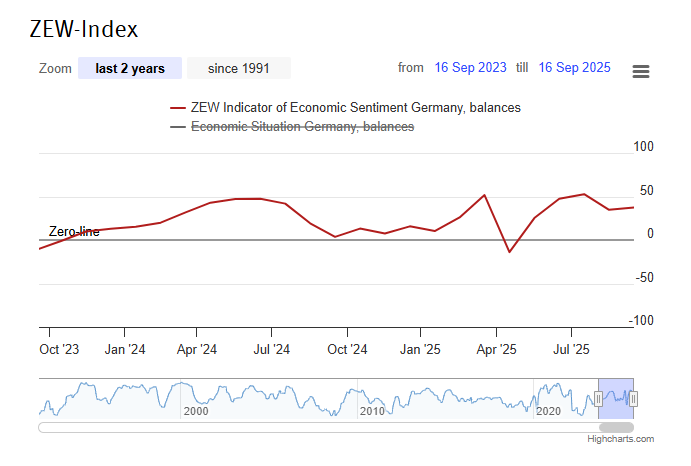
German investor confidence unexpectedly stabilized in September, even as Europe’s biggest economy experienced a steep drop in industrial jobs and business creation, showing “painful” signs of structural weakness.
The ZEW indicator of economic confidence rose unexpectedly to 37.3 in September from 34.7 in the previous month. Analysts had expected sentiment to fall to 26.3, according to data by Trading Economics.
The outlook has improved in particular for export-oriented sectors, which had recently suffered a substantial decline, ZEW said. However, the assessment of the current economic situation has deteriorated. It fell 7.8 points from the previous month to minus 76.4 points.
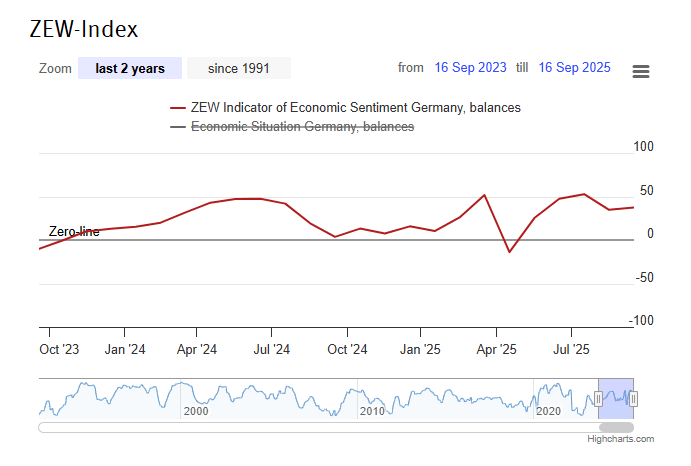
In contrast to Germany, the assessment of the economic situation in the eurozone has increased slightly, ZEW said. At minus 28.8 points, it is currently 2.4 points above the value recorded in the previous month.
Germany has witnessed a steep downturn in its once powerful industrial sectors, losing almost 250,000 jobs since 2019. German business startup creation has fallen to the lowest level in decades, hindered by bureaucracy and regulations.
“Financial market experts are cautiously optimistic and the ZEW indicator has stabilized, but the economic situation has worsened,” ZEW President Professor Achim Wambach said. “There are still considerable risks, as uncertainty about the US tariff policy and Germany’s ‘autumn of reforms’ continues.”
Bond Markets Reflect Increasing Concern About Germany
Germany reported an unexpected decline in exports in July, with goods shipped to the US falling to their lowest level since 2021. Exports to the US dropped 7.9% in July to €11.1 billion, extending a four-month decline.
The country’s export-oriented economy has contracted or flatlined nine out of the last 12 quarters. GDP …