
Austin, TX, USA, Sept. 12, 2025 (GLOBE NEWSWIRE) — Custom Market Insights has published a new research report titled “Indoor 5G Market Size, Trends and Insights By Component (Hardware, Software, Services), By Frequency Band (Sub-6 GHz, mmWave, Others), By Building (Residential, Commercial, Industrial), By End Use (Enterprises, Telecom Operators, Government, Others), and By Region – Global Industry Overview, Statistical Data, Competitive Analysis, Share, Outlook, and Forecast 2025 – 2034“ in its research database.
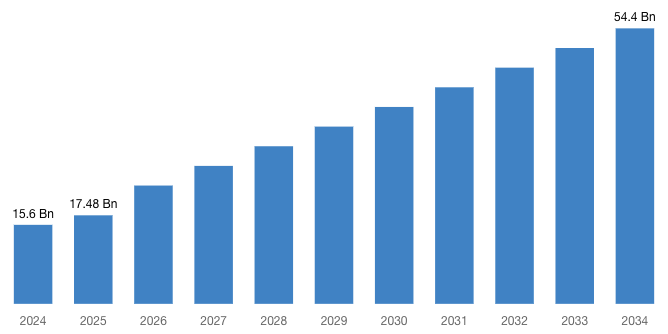 According to the latest research study, the global Indoor 5G Market size and share were valued at approximately USD 15.60 billion in 2024, are expected to reach USD 17.48 billion in 2025, and are projected to grow to around USD 54.40 billion by 2034, with a compound annual growth rate (CAGR) of about 13.4% during the forecast period from 2025 to 2034.
Click Here to Access a Free Sample Report of the Global Indoor 5G Market @ https://www.custommarketinsights.com/request-for-free-sample/?reportid=72233
Overview
As per the industry experts at CMI, the indoor 5G market is growing at an accelerated pace, with ultra-low latency and high-bandwidth connectivity being the focus of enterprises in smart buildings, hospitals, airports, and manufacturing centers. The small cell and mmWave use inside are being improved by the global players such as Ericsson, Huawei, Nokia, and Qualcomm, customized to the indoor environment. In North America, companies focus on privately using 5G networks and facilitating easy enterprise integration in their regions.
European businesses are approaching deployments toward carbon-neutral goals and digital sovereignty. Asia-Pacific is scaling up indoor 5G in response to smart city requirements in retail and transit hubs. Partnerships between donors and different industries, supportive policies for shared network management and AI, and compliance with local regulations are driving quick adoption and commercialization in both advanced and developing countries.
Key Trends & Drivers
Growing Demand in High-Speed Indoor Connectivity: The era of video conferencing, cloud computing, and mobile apps at office buildings, campuses, and commercially established centers has boosted the need of high-fast and reliable reception within the confines of buildings. 5G offers high-speed connections, low latency, and efficient spectrum usage, making it highly suitable for indoor environments that experience heavy user traffic and require data-intensive functions and seamless operations.
Expansion of Smart Buildings and IoT: Utilization of smart buildings depends on integrated systems, including HVAC, lighting, access control, as well as building asset tracking. Analog 5G allows back-bone technologies to enable real-time communication between 1000s of connected devices. The capability of massive IoT and network slicing enables flexible bandwidth provision, facilitating efficient management of devices in commercial rooms, healthcare facilities, and industrial plants to support smarter energy utilization, safety, and operational control.
Enterprise Digital Transformation: Companies are spending on digital infrastructure to enhance the productivity, automation of the processes, and mobile workforces. The transformation occurs through indoor 5G networks that allow edge computing, analytics powered by AI, and effortless cloud integration. Innovative companies in the manufacturing, retail, and logistics industries are using private 5G networks to support mission-critical applications, robotics, and AR/VR, which enables them to gain the scalability, agility, and operational efficiency of their businesses in controlled indoor environments.
Request a Customized Copy of the Indoor 5G Market Report @ https://www.custommarketinsights.com/request-for-customization/?reportid=72233
Government push and 5G policy support: The rollout of 5G is being driven by many governments, which have implemented national policies, provided spectrum access for indoor use, and funded 5G testbeds. Nations such as the United States, Germany, China, and South Korea have developed specific policies dedicated to the development of 5G and smart cities. These efforts will reduce the cost of enterprise deployment and encourage telecom operators and infrastructure providers to offer attractive incentives to vertically scale indoor 5G deployments within cities and industrial parks.
Report Scope
| Feature of the Report | Details |
| Market Size in 2025 | USD 17.48 Billion |
| Projected Market Size in 2034 | USD 54.40 Billion |
| Market Size in 2024 | USD 15.60 Billion |
| CAGR Growth Rate | 13.4% CAGR |
| Base Year | 2024 |
| Forecast Period | 2025-2034 |
| Key Segment | By Component, Frequency Band, Building, End Use and Region |
| Report Coverage | Revenue Estimation and Forecast, Company Profile, Competitive Landscape, Growth Factors and Recent Trends |
| Regional Scope | North America, Europe, Asia Pacific, Middle East & Africa, and South & Central America |
| Buying Options | Request tailored purchasing options to fulfil your requirements for … |