
Austin, TX, USA, Sept. 09, 2025 (GLOBE NEWSWIRE) — Custom Market Insights has published a new research report titled “Assistive Technology Market Size, Trends and Insights By Mobility Aids (Wheelchairs, Mobility Scooters, Walking Aids, Prosthetics & Orthotics, Others), By Hearing Aids (Behind-the-Ear (BTE), In-the-Ear (ITE), Receiver-in-Canal (RIC), Cochlear Implants, Others), By Vision Aids (Magnifiers, Braille Displays, Screen Readers, Smart Glasses, Others), and By Region – Global Industry Overview, Statistical Data, Competitive Analysis, Share, Outlook, and Forecast 2025 – 2034“ in its research database.
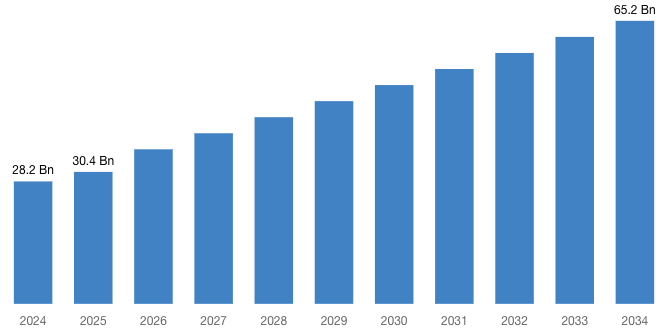
According to the latest research study, the global assistive technology market size and share were valued at approximately USD 28.2 billion in 2024, are expected to reach USD 30.4 billion in 2025, and are projected to grow to around USD 65.2 billion by 2034, with a compound annual growth rate (CAGR) of about 8.9% during the forecast period from 2025 to 2034.
Click Here to Access a Free Sample Report of the Global Assistive Technology Market @ https://www.custommarketinsights.com/request-for-free-sample/?reportid=73258
Overview
The global population is fast-growing older with an increasing prevalence of disabilities and chronic conditions; thus, the market for assistive technology is rapidly evolving. Elderly and older adults suffer from mobility, vision, and hearing impairments-even today-so the demand for wheelchairs, prosthetics, hearing aids, and vision-support devices continues to rise. Parallelly, Indian lifestyle-related conditions like diabetes and arthritis, accidents on roads, and neurological problems keep adding to the increasing list of those requiring assistive treatments.
This demographic path is most striking in the more developed regions such as North America, Europe, and Japan, while assisted technology adoption is gaining ground in emerging economies. The need for independence, quality of life, and inclusive participation in education and employment are additional factors boosting the demand for assistive technology worldwide.
Key Trends & Drivers
- Technological Advancements: AI, IoT, robotics, and wearable technologies are offering a new edge to assistive technologies. Smart hearing aids, robotic exoskeletons, and AI-powered vision aids promote greater independence and personalization of user experience. Features such as smartphone connectivity, lightweight designs, and real-time adaptability serve to enhance the assistive solutions’ user experience. Now, these industrial setups have named the applications of these technological innovations as assistive technologies for a broader range of users, bringing the market closer to harmonious digital health ecosystems. Consequently, the integration of medical functions with consumer electronics in advanced technology leads to greater acceptance and, in turn, a long-term demand that spreads across global territories in healthcare, education, and home construction.
- Aging Population: Rising elderly population forces huge demand on mobility, hearing, and vision aids. Older patients suffer from arthritis, hearing loss, and visual impairment; hence, assistive devices become a way of maintaining independence. Countries with a high aging rate, like Japan, Germany, and the US, have excellent adoption rates because of their supportive health care structures. Emerging economies are actively expanding their elderly care schemes, which is driving their growth. This demographic sustains market growth over an extended period, as rising longevity and the increasing incidence of chronic illnesses have made assistive technology essential for global health and elderly care.
Request a Customized Copy of the Assistive Technology Market Report @ https://www.custommarketinsights.com/request-for-customization/?reportid=73258
- Policy and Reimbursement Support: The adoption is highly dependent upon government policies and reimbursement schemes. Subsidies, commercialization through the inclusion of disability frameworks, and coverage through insurance mechanisms all contribute toward removing cost barriers. The UN Convention on the Rights of Persons with Disabilities and other regulations create a stronger commitment to ensuring accessibility. The programs of public procurement, collaboration with NGOs, and alternative mandates support further awareness and adoption. These are measures that ensure that innovations are stimulated, that manufacturers are helped in growing their portfolio quantities, and that the market is sustained in both advanced and emerging economies.
- Regional Disparities: The regional factors show differences in a market. North America and Europe dominate due to the advanced infrastructure of health systems, strong reimbursement policies, and the presence of manufacturers who understand the price. Asia-Pacific, on the other hand, is the fastest-growing region, supported by increasing government initiatives in favor of local production and by rapidly aging populations in Japan and China. On the contrary, Latin America and Africa face constraints such as affordability, infrastructure, and dependence on imports. Such disparity provides a dual speed to the market, where developed economies lead in premium innovations, whereas emerging markets are geared towards affordable and scalable solutions that can cater to the growing demand.
- Affordability Challenges: High price tags on assistive devices undoubtedly remain the main challenge in low- and middle-income economies. In terms of affordability, smart prosthetics, power wheelchairs, and cochlear implants are the most expensive assistive technologies, limiting their widespread adoption. Import duties and tariffs imposed by various governments have only gone to raise the prices. Despite the efforts of numerous NGOs, local manufacturers, and subsidy programs to address the affordability gap, many users continue to rely on basic assistive technologies. For manufacturers to achieve their long-term expansion goals, they are now concentrating on innovative pricing strategies, local production, and product tiering. In this instance, balancing high-end innovation with affordable accessibility will be vital to ensure equitable adoption worldwide.
- Innovation vs. Accessibility: Innovation is fast-tracking the prosperity of assistive technology, but, at the same time, will counter some remaining accessibility challenges. Technologies are advancing in developed markets but are elusive to those with limited resources. Affordability, infrastructure, and awareness to counterbalance these gaps are a few things governments and NGOs place increasing emphasis on. These issues resulted in manufacturers developing a two-pronged approach: one in support of innovation and accessibility for developed economies and one for low-cost devices and services for emerging markets. The balance between innovation and accessibility will therefore determine the future direction of the global market in making sure that assistive technologies continue to evolve and have an impact on society at large.
Report Scope
| Feature of the Report | Details |
| Market Size in 2025 | USD 30.4 Billion |
| Projected Market Size in 2034 | USD 65.2 Billion |
| Market Size in 2024 | USD 28.2 Billion |
| CAGR Growth Rate | 8.9% CAGR |
| Base Year | 2024 |
| Forecast Period | 2025-2034 |
| Key Segment | By Mobility Aids, Hearing Aids, Vision Aids and Region |
| Report Coverage | Revenue Estimation and Forecast, Company Profile, Competitive Landscape, Growth Factors and Recent Trends |
| Regional Scope | North America, Europe, Asia Pacific, Middle East & Africa, and South & Central America |