
Austin, TX, USA, Sept. 09, 2025 (GLOBE NEWSWIRE) — Custom Market Insights has published a new research report titled “Talc Filler Masterbatch Market Size, Trends and Insights By Polymer Type (Polypropylene (PP), Polyethylene (PE), Polystyrene (PS), Polyvinyl Chloride (PVC), Others), By Form (Pelletized Masterbatch, Powdered Masterbatch), By Talc Particle Size (Fine Talc (Micronized Talc), Coarse Talc), By End-use Industry (Automotive, Building & Construction, Packaging, Agriculture, Medical, Other Industries), and By Region – Global Industry Overview, Statistical Data, Competitive Analysis, Share, Outlook, and Forecast 2025 – 2034“ in its research database.
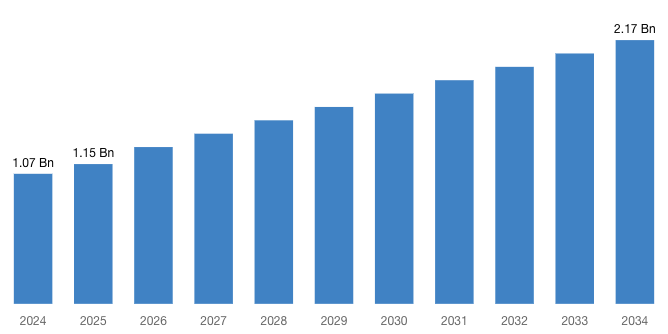
“According to the latest research study, the demand of global Talc Filler Masterbatch Market size & share was valued at approximately USD 1.07 Billion in 2024 and is expected to reach USD 1.15 Billion in 2025 and is expected to reach a value of around USD 2.17 Billion by 2034, at a compound annual growth rate (CAGR) of about 7.31% during the forecast period 2025 to 2034.”
Click Here to Access a Free Sample Report of the Global Talc Filler Masterbatch Market @ https://www.custommarketinsights.com/request-for-free-sample/?reportid=73253
Overview
According to industry experts at CMI, the implementation of new strategies and technologies by the manufacturers presents lucrative opportunities for players in the Talc Filler Masterbatch Market during the forecast period. Furthermore, the growing significance of organized retailing is expected to drive the future growth of the market.
Key Trends & Drivers
- Increased Use in Lightweight Automotive Applications: Growing use in lightweight car parts is one of the main factors driving the talc filler masterbatch market. The automakers are adopting the talc-filled polypropylene for reducing the vehicle weight along with improving the fuel efficiency and complying with the strict emission standards. Talc strengthens rigidity, dimensional stability, and heat resistance in components such as dashboards, bumpers, and door panels. The rise of electric vehicles is adding further momentum to this trend, since vehicle weight directly affects battery performance and driving range. With tightening environmental regulations and consumers favoring energy-efficient cars, the use of talc filler masterbatch in the automotive sector is expected to keep expanding quickly.
- Sustainability and Recyclability in Plastics: The manufacturers are focusing onsustainable solutions where talc filler masterbatch has an important role owing to increasing environmental concerns and stringent regulations. The talc filled masterbatches allow the downgauging, which reduces the plastic thickness without sacrificing strength, along with helping to reduce the raw material consumption. The talc also boosts the recyclability, as it improves the mechanical properties in the recycled polymers, which makes it a top choice for eco-friendly packaging and industrial uses. The companies are further developing the bio-based and recyclable formulations for aligning with the circular economy targets. As sustainability becomes a core business priority, the demand for talc-filled masterbatches that enable greener production is expected to grow significantly worldwide.
Request a Customized Copy of the Talc Filler Masterbatch Market Report @ https://www.custommarketinsights.com/request-for-customization/?reportid=73253
- Growing Packaging Industry with Performance Needs: The rising e-commerce along with food delivery and pharmaceutical sectors is projected to drive the growth of the packaging industry which will increase the demand for the talc filler masterbatch market. Talc improves rigidity, printability, and heat resistance in packaging films, containers and caps, improving overall cost efficiencies. Talc has properties that allow for the ability to downgrade plastic while enhancing barrier properties, making it a perfect filler for food and beverage packaging where compatibility by means of strength and safety of packaging is paramount. At the same time, the continued consumer demand for environmentally friendly and recyclable options for packaging continues to demonstrate the opportunities for talc in bio-based polymers. This trend is particularly evident in the emerging economies as rising consumerism and online retailing redefine the requirements along with standards of packaging.
- Polymer Compounding Technology Innovations: The aesthetic and mechanical benefits of talc are reliant on the micro fillers’ correct dispersion within polymer matrices, and modern compounding techniques are progressively helping to achieve this goal. The modern compounding techniques improve the quality of the end product by helping in achieving the uniform talc dispersion in polymer matrices whilst simultaneously reducing the mold shrinkage. In addition to this, talc grades that have been custom made for specific industries, such as the automotive, electronics, and medical devices industries, make it possible for manufacturers to provide highly specific target devices.
- Rising Deployment in Agriculture Applications: Agricultural films, irrigation pipes, and greenhouse covers are seeing greater use of talc filler masterbatch to boost durability, UV resistance, and thermal stability. Talc improves the mechanical strength of mulching and silage films, which provides them a longer service life and makes them more cost-effective for farmers. With the increasing adoption of the advanced farming and plasticulture practices, the demand for performance-enhancing additives like talc is increasing. Talc-filled masterbatches also provide downgauging opportunities and cost savings in agricultural films without sacrificing strength. The opportunity to reduce raw material costs is particularly strong in developing countries, where agriculture plays an essential role in the economy and farm inputs are valued for efficiency.
- Industrialization and Urbanization in Emerging Economies: The rapid industrialization along with increasing urbanization are expected to propel the demand for the talc filler masterbatch market, especially in the southeast Asia, Latin America, and the Middle East. These regions have key industrial sectors such as automotive, construction, and packaging, which are looking for the high performance and low-cost products that help in facilitating the growth of the talc filled masterbatch market. Domestic production capacity is increasing, and local production can be competitive with an offer of talc-filled masterbatches for domestic consumption. Furthermore, government sponsored infrastructure/industrial development also provides various opportunities for growth.
Report Scope
| Feature of the Report | Details |
| Market Size in 2025 | USD 1.15 Billion |
| Projected Market Size in 2034 | USD 2.17 Billion |
| Market Size in 2024 | USD 1.07 Billion |
| CAGR Growth Rate | 7.31% CAGR |
| Base Year | 2024 |
| Forecast Period | 2025-2034 |
| Key Segment | By Polymer Type, Form, Talc Particle Size, End-use Industry and Region |
| Report Coverage | Revenue Estimation and Forecast, Company Profile, Competitive Landscape, Growth Factors and Recent Trends |
| Regional Scope | North America, Europe, Asia Pacific, Middle East & Africa, and South & Central America |
| Buying Options | Request tailored purchasing options to fulfil your requirements for research. |
(A free sample of the Talc Filler Masterbatch report is available upon request; please contact us for more information.)
Our Free Sample Report Consists of the following:
- The updated report for 2025 includes an …