
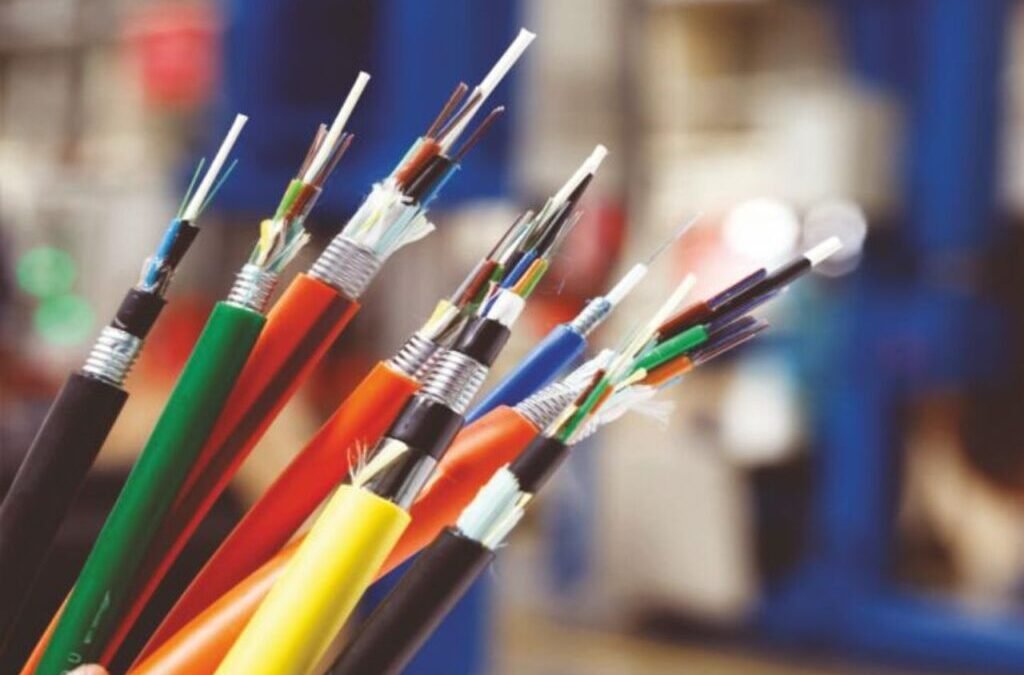
Synopsis: Optical fibre stocks have delivered sharp gains of up to 220 percent in a short span, driven by rising data centre demand, 5G rollout and global fibre recovery. While momentum looks strong, the underlying story is shifting toward higher-value products, exports and technology-led growth across the sector.
A set of optical fibre and connectivity-focused stocks have seen a sharp surge in a very short period, delivering returns of up to 220 percent as multiple demand triggers begin to align. The rally appears to be driven by a mix of improving global fibre demand, rising data centre investments, and increasing participation in next-generation digital infrastructure.
Sterlite Technologies – 224 Percent
Sterlite Technologies is positioning itself as a play on a much larger digital infrastructure cycle rather than just a traditional fibre cable maker. The company sits across the optical connectivity value chain, from optical fibre and fibre cables to specialty cables and connectivity products, while also running a smaller digital solutions business. In simple terms, it helps build the backbone that powers telecom networks, broadband expansion, data centres and enterprise connectivity. Management’s current strategy is centered on gaining market share in optical networking, improving the share of higher-value connectivity products, and building out a stronger data centre-focused portfolio.
What appears to be working in STL’s favour right now is that multiple demand cycles are lining up together. The company has repeatedly highlighted three broad drivers: FTTx rollouts, data centre expansion and 5G network buildout. Among these, data centres seem to be the most important near-term opportunity. STL says AI-led infrastructure is making data centres far more fibre-intensive than before, with GPU-dense setups requiring much more fibre than older CPU-based architectures. That is why the company is increasingly pushing an “AI-ready” optical portfolio aimed at hyperscalers, inter-data centre links and high-density network builds. In the first nine months of FY26, enterprise and data centre products contributed 20 percent of revenue, and management said it expects this share to move toward 30 percent over the next 12 to 18 months.
The latest quarter also showed that the operating momentum has improved. In Q3FY26, STL’s consolidated revenue stood at Rs. 1,257 crore, while the Optical Networking business generated Rs. 1,174 crore. Optical revenue improved both sequentially and year-on-year, supported by better volumes. Order momentum also remained healthy, with 9MFY26 order intake rising to Rs. 4,263 crore from Rs. 3,038 crore a year earlier. Its open order book stood at Rs. 5,325 crore at the end of Q3FY26, which gives the company reasonable visibility for the coming quarters. Management said this traction has been driven by large data centre connectivity wins, entry into Tier-1 North American telecom accounts, and a more diversified mix of capex-led projects and long-term service contracts.
At the same time, profitability is still in a transition phase. Q3FY26 EBITDA margin came in at 10.3 percent at the consolidated level and 11.2 percent in the Optical Networking business, with management clearly attributing the pressure to tariff-related headwinds in the U.S. market. Even so, the company sounded confident that the underlying margin trend is improving, helped by better utilization, richer product mix and a rising contribution from North America. Management also indicated that it is working on mitigation measures such as passing on part of the tariff burden and ramping up local production at its U.S. facility.
The bigger part of the STL story now is innovation. During the quarter, the company expanded its data centre and connectivity portfolio, including higher-count ribbon cable products and compact solutions meant for denser deployments. More importantly, recent developments show where STL wants to go next. In January 2026, it completed Multi-Core Fibre trials with Colt in the U.K., where its 4-core fibre was tested across Colt’s London metro network and achieved an 800 Gbps line rate. Then, in March 2026, STL announced India’s first Hollow Core Fibre cable for data centre networks, designed for lower-latency and higher-bandwidth use cases. The company says this technology can enable signals to travel around 46 percent faster by using an air-filled core instead of a solid glass core.
Overall, STL looks like a company trying to move from being seen only as an optical cable supplier to becoming a broader technology-led connectivity player. The current quarter suggests that demand recovery, especially in data centres and North America, is helping volumes and orders. The next phase will depend on whether it can keep scaling its higher-value portfolio, improve connectivity attach rates, and turn its innovation pipeline in areas like multi-core and hollow-core fibre into commercially meaningful growth.
HFCL – 59 Percent
HFCL is no longer just a telecom project player. The company is increasingly shaping itself as a product-led connectivity and technology business with growing exposure to optical fibre, telecom equipment, passive connectivity solutions, data centre products and defence electronics. Its presence today spans telecom, defence and system integration, but the most important shift in the current phase is that HFCL is moving toward higher-value products, stronger exports and a broader role in next-generation digital infrastructure. Management has been clear that the company wants to improve its revenue mix by increasing the share of products and private customers while also building a larger international business.
What appears to be driving HFCL right now is the sharp recovery in global optical fibre cable demand, especially from hyperscalers, AI-led data centre buildouts and high-capacity connectivity projects. Management said the demand environment has changed meaningfully, with customers now increasingly seeking high-fibre-count, high-performance cables rather than standard telecom deployments. That matters because HFCL has been building capabilities in exactly this direction. During the quarter, it developed a 3456-fibre Micro Duct IBR cable and said it is now working on 6912-fibre variants as well. According to management, only a limited number of global manufacturers can produce such complex cables at scale, which gives HFCL a stronger position in a market where product quality, manufacturing precision and reliability are becoming more important.
The latest quarter also showed that this shift is beginning to reflect in the numbers. In Q3FY26, HFCL reported revenue of Rs. 1,210.79 crore, EBITDA of Rs. 243.52 crore and profit after tax of Rs. 102.37 crore. EBITDA margin improved to 20.11 percent and PAT margin to 8.45 percent. The order book also rose to Rs. 11,125 crore from Rs. 9,981 crore in Q2FY26. A notable part of the improvement came from better product mix and a stronger export contribution. Product revenues formed 60 percent of total revenue in the quarter, while exports contributed 27 percent compared with 14 percent a year ago. Management described this as a structural shift, showing that HFCL is becoming less dependent on low-margin project revenue and more oriented toward products and overseas markets.
The export side looks especially important. During Q3FY26, the company secured export orders worth about USD 192 million, largely led by optical fibre cable demand. Management said international demand had strengthened after a period of slower spending and inventory correction, and that improving industry conditions were also helping realizations. In the concall, it indicated that OFC realization rose to around Rs. 1,055 per fibre kilometre from Rs. 964 in the previous quarter, and also said prices could move further if current demand trends continue. This suggests that HFCL is not just seeing volume recovery but also benefiting from a better pricing environment.
Recent developments also reinforce that momentum. In March 2026, HFCL entered into a five-year supply agreement through its overseas wholly owned subsidiary for high-fibre-count OFC, with total potential value estimated at about USD 1.10 billion, or roughly Rs. 10,159 crore, through December 2030. The company called this the first long-term multi-year OFC supply arrangement of this nature in its history. Then in April 2026, its material subsidiary HTL secured domestic OFC orders worth about Rs. 1,366 crore from a Tier-1 customer, to be executed by December 2026. Together, these developments strengthen the view that HFCL is gaining scale and credibility in optical connectivity, both globally and in India.
Beyond cables, HFCL is also trying to widen its role in data centre connectivity and defence. It has started its pre-connectorised solutions business for data centres and has begun MPO cable production, with management expecting these newer interconnect businesses to add meaningful revenue over FY26 and FY27. On the defence side, it continues to develop products such as electronic fuzes, thermal cameras, radars and other indigenous systems, while also preparing land in Andhra Pradesh for a larger defence manufacturing base. Overall, HFCL today looks like a company benefiting from the optical upcycle, but the bigger story may be that it is steadily moving from being seen as a cable and project company to becoming a broader product and technology-led infrastructure player.
Disclaimer: The views and investment tips expressed by investment experts/broking houses/rating agencies on tradebrains.in are their own, and not that of the website or its management. Investing in equities poses a risk of financial losses. Investors must therefore exercise due caution while investing or trading in stocks. Trade Brains Technologies Private Limited or the author are not liable for any losses caused as a result of the decision based on this article. Please consult your investment advisor before investing.
The post 2 Optical Fibre Stocks That Surged Up To 220% In Just 57 Days appeared first on Trade Brains.